
Learning how to become a family friendly employer starts with one insight: it is not a launch event. Some companies try to get there with one announcement, usually a new leave policy and a press release. They often find that little changes for the people who need it most. The shift worker still gets her schedule on Thursday for the following Monday. The father who asks for parental leave still senses that his manager is not pleased.
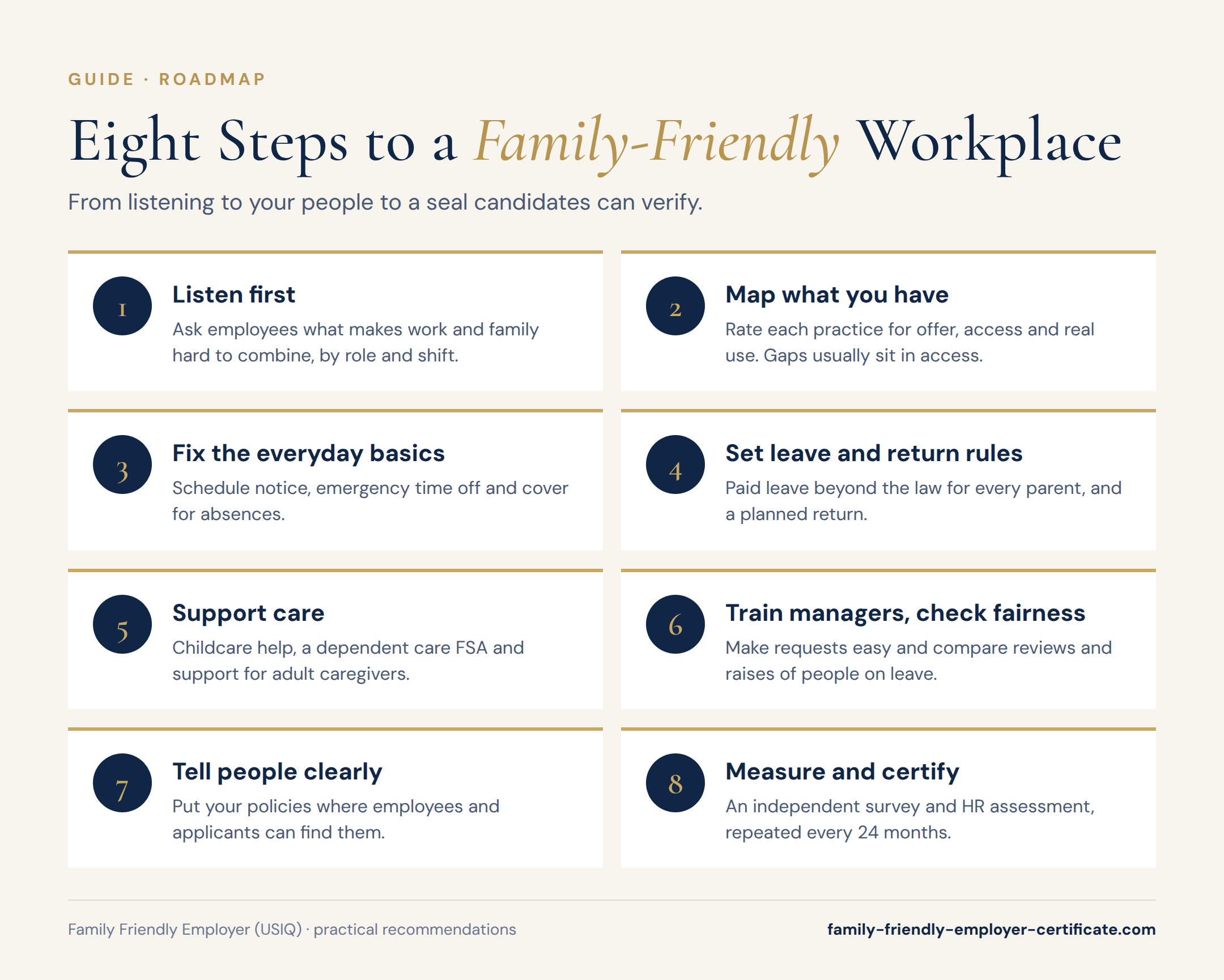
What works is a sequence of practical steps. Find out where work and family actually collide, and fix the everyday problems first. Then add the benefits that matter most to your workforce and have the result checked from the outside. This step-by-step guide walks through them in the order in which they tend to work best. It is written for HR teams and owners of companies of every size. Where they help, it refers to the published Family Friendly Employer criteria.
Step 1: Listen before you write policies
The most common mistake is to start with benefits. A company introduces backup childcare, and it turns out that most employees have school-age children and struggle with something else entirely: unpredictable shifts or meetings at 5 p.m.
Different groups need different things, and the differences are large. In a Pew Research Center survey of 2,242 working parents from March 2026, 70% of upper-income parents who are not self-employed had access to paid parental, family or medical leave, compared with 33% of lower-income parents. Asked whether they would worry about losing pay if they had to take time off for a sick child or a breakdown in childcare, 52% of lower-income parents said they would be extremely or very worried, compared with 8% of upper-income parents.
So ask first. A short anonymous pulse survey and a few small-group conversations by shift and location are a good start. Your own data on overtime and short-notice absences then shows where the friction is. USIQ’s guide on running employee surveys that staff trust explains how to keep such surveys anonymous and useful. Ask about situations, not about family status. Nobody should have to disclose a pregnancy or a sick parent in an employee survey. The Family Friendly Employer survey does not ask about it either.
Step 2: Map what you already offer
Most employers already do more than they realize, and less than they think. The way to find out is to rate every family-related practice on three questions:
- Offer: Does the practice exist, and is it written down?
- Access: Who can actually use it? Part-time employees, hourly staff, night shifts, remote workers, every location?
- Practice: Do people use it, and does using it have any negative consequences for them?
This is exactly how the family-focused HR assessment works. A reviewer rates each criterion on all three questions, and the lowest rating counts. A benefit only earns full credit if at least 80% of the covered workforce can use it. Doing this exercise yourself first shows you where the real gaps are. In most organizations, they are in access, not in the offer.
Use the eight areas of the assessment as a checklist. They cover scheduling, leadership, flexible work, pregnancy and parental leave, childcare and caregiving, fairness, candidate experience and life events. Our guide to the eight areas explains each one in more detail.
Step 3: Fix the everyday basics
The cheapest changes often have the biggest effect, because they affect people every week rather than once in a career.
- Schedule notice: publish shift plans at least 14 days in advance and keep track of changes at short notice.
- Meetings and training: hold mandatory meetings, training and company events inside agreed working hours, with alternatives for night, weekend, part-time and on-site groups.
- Family emergencies: create a simple process for taking time off at short notice that works on every shift.
- Cover: plan who covers whom during leave and sudden absences. Then colleagues do not carry a constant extra load, and nobody feels guilty for being away.
These points sound modest. But they decide whether family-friendliness is real for employees who do not sit at a desk. They are also what candidates hear about from people who already work for you.
Step 4: Set clear rules for leave and the return to work
Federal law sets a low floor. The Family and Medical Leave Act provides up to 12 weeks of unpaid, job-protected leave for eligible employees of employers with 50 or more staff. Twelve states and the District of Columbia pay benefits through state paid family leave programs, with Maryland and Virginia set to follow in 2028, and many employers add their own pay on top. The 2026 SHRM Employee Benefits Survey found that 46% of employers now offer paid parental leave.
A family-friendly leave policy has a few features in common (our guide to building a paid parental leave policy covers the design choices in detail):
- It pays more than the law requires, ideally for several weeks at full or close to full pay.
- It applies to all parents: mothers, fathers and partners, adoptive and foster parents.
- It covers caregiving for other family members, not just newborns.
- It reaches part-time and hourly employees, not only salaried staff.
Fathers deserve special attention, because they often do not take leave even when they can. Research on California’s paid family leave program by Ann Bartel and colleagues found that fathers of infants were 46% more likely to be on leave once the program was available. Paid leave clearly helps. In many companies, though, the decisive factor is whether senior men take it themselves. Managers also need to make clear that doing so will not hurt anyone’s career.
Plan the return to work
The return to work deserves as much attention as the leave. Agree in advance on a phased return, for example reduced hours for the first weeks. Adjust targets, goals and bonus calculations for the time away. Offer a short conversation before the first day back. Pregnant employees are entitled to reasonable accommodations under the Pregnant Workers Fairness Act. Nursing employees have a right to break time and a private space under the PUMP Act. A family-friendly employer treats these as a starting point, not as the goal.
Step 5: Support employees with care responsibilities
Childcare is often the single largest obstacle. Child Care Aware of America reports a national average price of $13,128 a year for 2024. Employers have a range of options, from inexpensive to substantial:
- Information and referral: help employees find local providers, summer programs and eldercare services.
- A dependent care flexible spending account. From 2026, employees can set aside up to $7,500 a year pre-tax if the employer has amended the plan.
- Backup care for days when regular arrangements fall through.
- Childcare subsidies or reserved places with local providers.
- On-site or near-site care, which only a small share of employers provide. In the Pew survey, just 6% of working parents said it was available where they work.
Since 2026, the federal employer-provided childcare credit covers 40% of qualified childcare expenditures, or 50% for eligible small businesses. That makes the options further down the list more realistic than before.
Do not forget employees who care for adults. AARP and the National Alliance for Caregiving count 63 million family caregivers in the United States. Leave for any close relative, flexible hours without a need to explain why and information about local support services cost little. They help a large group that often stays invisible.
Step 6: Train managers and check for fairness
Managers decide whether policies work. Gallup estimates that managers account for at least 70% of the variance in employee engagement scores across business units. In family matters, the effect is probably just as strong: the same policy feels generous under one manager and impossible to use under another.
Give managers clear guidance on how to handle requests for flexibility and leave, what they may and may not ask, and how to plan cover. Make training part of every new manager’s onboarding rather than a one-off workshop.
Then check whether family responsibilities affect careers. Compare performance ratings, raises and promotions of employees who took parental or caregiving leave with those who did not. If there is a gap, find out why. The EEOC’s guidance on workers with caregiving responsibilities explains how assumptions about mothers, fathers and caregivers can lead to unlawful treatment. A typical case is a manager who decides, without asking, that a mother of young children would not want a role with more travel.
Step 7: Tell employees and candidates clearly
A policy that nobody knows about does not help anybody. Employees should be able to find the rules on flexibility, leave and emergencies in one place, written in plain language. Candidates should be able to see the essentials on your careers page without having to ask. Many will not raise family questions in an interview for fear of being judged.
Be specific. “Family-friendly culture” says nothing. “Sixteen weeks of fully paid parental leave for all parents, schedules published 14 days ahead, and a same-day process for family emergencies” says a great deal. Our article on how family-friendly policies help you attract talent shows which information candidates look for.
Step 8: Measure, certify and repeat
Once the basics are in place, an independent assessment shows whether the changes have reached employees. It also gives candidates a reason to believe your careers page.
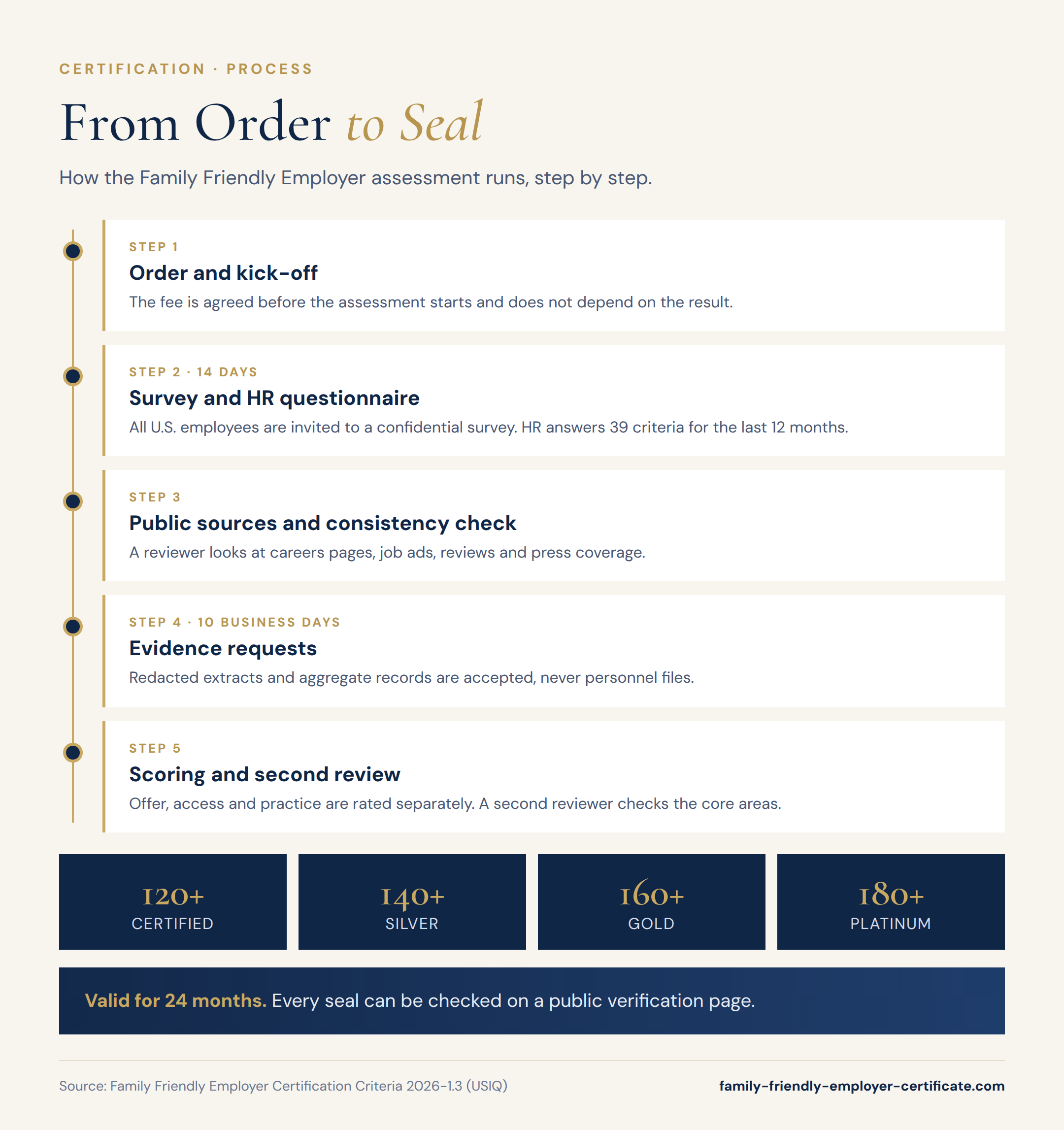
The Family Friendly Employer certification combines two equally weighted parts. In the confidential employee survey, every employee on the U.S. payroll is invited to answer 46 questions in about 8 to 10 minutes. The two family items, on work-life balance and on working-time flexibility, carry 50 of the 100 survey points. In the HR assessment, your HR team answers 39 family-focused criteria for the last 12 months. A trained reviewer scores them against the evidence, and a second reviewer checks the core areas and a random share of the rest.
An employer needs at least 120 of 200 points for Certified, 140 for Silver, 160 for Gold and 180 for Platinum. It must also meet minimums in each part and in the three core areas of flexibility, parental leave and family benefits. The certificate is valid for 24 months, and repeating the assessment shows whether things have actually improved. The details are in our methodology and on the methodology page of USIQ. The sample report shows a complete example of the results, and the pricing page lists the four packages. Smaller companies should also read our guide to certification for small businesses.
Once you hold the seal, our guide on using the seal in recruiting shows where it does the most good.
Common mistakes to avoid
- Benefits for some, not all: generous policies for headquarters staff and nothing for shift workers create resentment. They also do not hold up in an assessment.
- Policies without cover: leave that leaves colleagues overloaded makes everyone reluctant to use it.
- Mothers only: policies aimed only at mothers reinforce the idea that care is a women’s issue and can disadvantage women in hiring and promotion.
- Promises without proof: a careers page full of claims that employees do not recognize damages trust more than saying nothing.
- One-time projects: family-friendliness erodes quickly when a new manager or a busy season arrives. Review it every year.
FAQ: how to become a family friendly employer
How long does it take to become a family friendly employer?
That depends on where you start. Many employers can fix the everyday basics within a few months. The assessment itself is shorter. The employee survey runs for 14 days, and you can extend it once by seven days. Evidence requests get an answer within 10 business days.
Do we have to ask employees about their family situation?
No, and you should not. Policies should be open to everyone with caring responsibilities. The Family Friendly Employer survey never asks about pregnancy, children, caregiving or family status.
Can we certify only one location?
The survey invites the whole U.S. workforce, so the result reflects the entire organization in the United States.
Is the HR assessment a legal compliance audit?
No. It checks family-focused practices against published criteria and evidence. It does not replace advice from an employment lawyer, and it gives no verdict on legal compliance.

About the author
PhDr. Oliver Scharfenberg, MBA
Oliver Scharfenberg sits on the Scientific Advisory Board of USIQ, which issues the Family Friendly Employer certificate. His doctoral thesis (2024) analyzed employer seals and included a randomized experiment with 1,093 participants on how a seal changes the way applicants react to a job ad. He previously served as a lay judge on the commercial chamber of the Regional Court of Berlin, hearing unfair competition cases, and is CEO of Syntharis Group.
Next step
Show Candidates How Work and Family Fit
The Family Friendly Employer (USIQ) certificate combines a confidential employee survey with a family-focused HR assessment against 39 published criteria. One-time packages start at $2,990.
About half of U.S. private-sector workers still lack paid family and medical leave. How to set eligibility, weeks and pay, treat every parent equally, coordinate with state programs and use the permanent 45S credit.
Child care costs keep rising while few workers get any help from their employer. Here is what U.S. companies can offer, which tax rules changed in 2026, and how to measure results.
What makes an employer family friendly? The eight areas that count, where U.S. law sets the floor, current data on working families, and how certification checks the claim.