
Almost every company now calls itself a family friendly employer. The phrase shows up on careers pages, in job ads and in recruiting videos. Usually it sits next to a photo of a smiling parent with a laptop. What it rarely comes with is a definition. That makes the claim easy to write and hard to check. Candidates deciding where to work struggle with it, and so do employers who want people to take them seriously.
This guide explains what a family-friendly employer actually is and which policies and practices count. It also shows where U.S. law already sets a floor and how an independent certification tests the claim. We wrote it for HR leaders and business owners, but candidates will find the checklist near the end useful as well.
A working definition
A family-friendly employer is an organization whose policies and daily practices make good work realistic for people who also care for others. Those others may be children, a partner, aging parents or other relatives. The important word is realistic. A generous handbook means little if managers frown on people who use it. The same goes for shift plans that change at a day’s notice, or a policy that only covers salaried staff at headquarters.
International organizations describe the same idea in terms of concrete benefits. UNICEF has published guidance for businesses on the topic. It groups family-friendly workplace policies around paid parental, sick and family leave, flexible work, support for breastfeeding and access to affordable, good-quality childcare. That list is a good starting point, but it is incomplete for everyday working life. Scheduling, the attitude of direct managers and fair pay and promotion for parents matter just as much. In practice, this is often where family-friendliness fails.
So a useful definition has three parts:
- The offer: what the employer provides, such as leave, flexibility or childcare support.
- Access: who can actually use it, including part-time employees, shift workers and people at every location.
- Practice: whether people can use it without hurting their careers, and whether the team has cover when someone is away.
An employer that scores well on only one of the three is not family friendly in any meaningful sense. A company with excellent paid leave that nobody dares to take has an offer but not a practice.
Why the term needs a clear definition
There is no legal definition of “family friendly” in the United States, and no agency checks the claim. Any employer can use it in an ad. For candidates, this creates a familiar problem. Every careers page sounds alike, and the differences only show after you sign the offer letter.
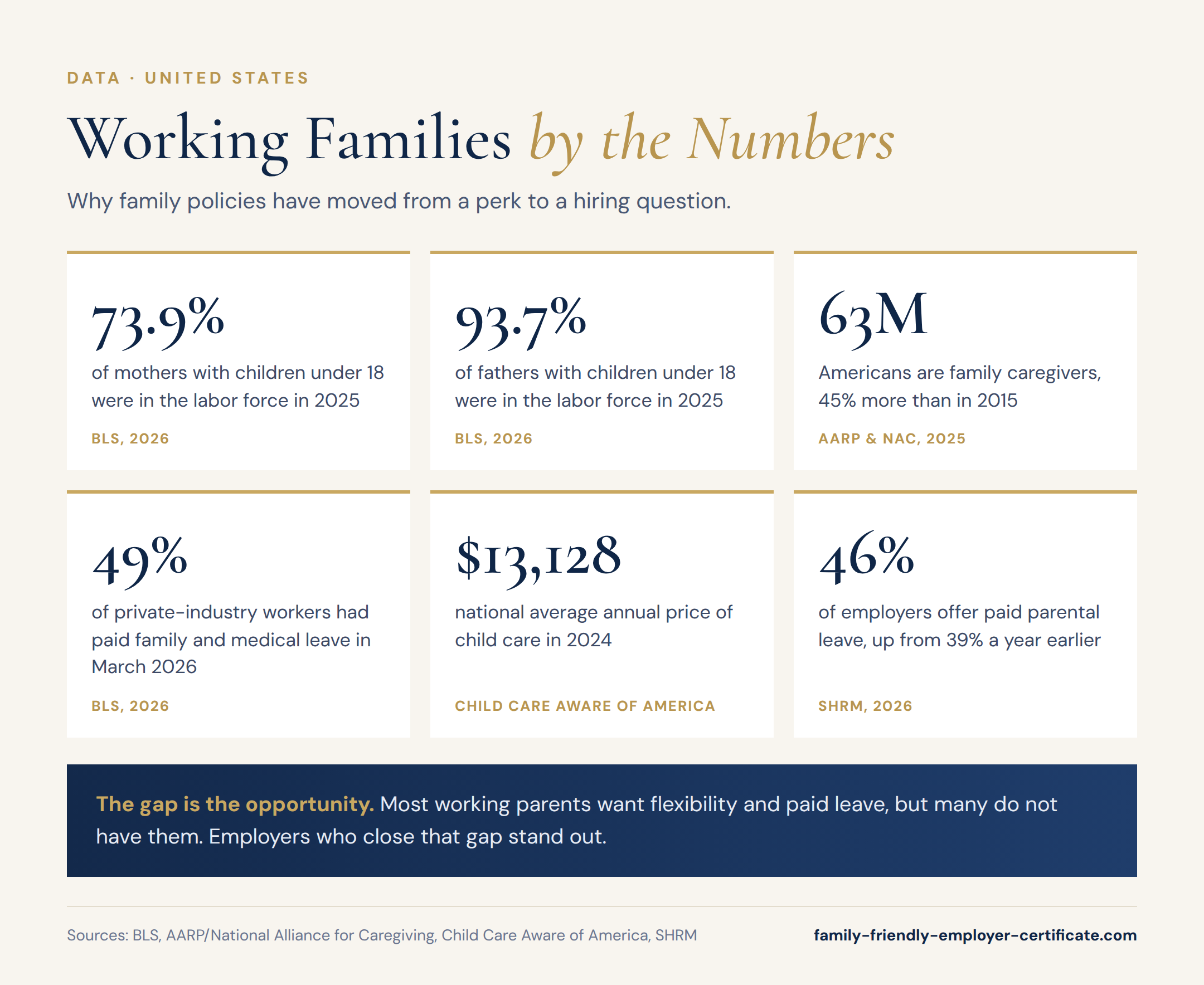
The numbers show why this matters to so many people. In 2025, 73.9% of mothers and 93.7% of fathers with children under 18 were in the labor force, according to the Bureau of Labor Statistics. Caregiving does not stop when children grow up either. The Caregiving in the US 2025 report by AARP and the National Alliance for Caregiving counts 63 million family caregivers, about one in four adults. Of these, 29% care for children and adults at the same time.
When this many employees juggle work and family, a vague promise is not enough. People want to know what an employer will do when a child is sick, when a parent needs surgery, or when a baby arrives.
The eight areas that make a workplace family friendly
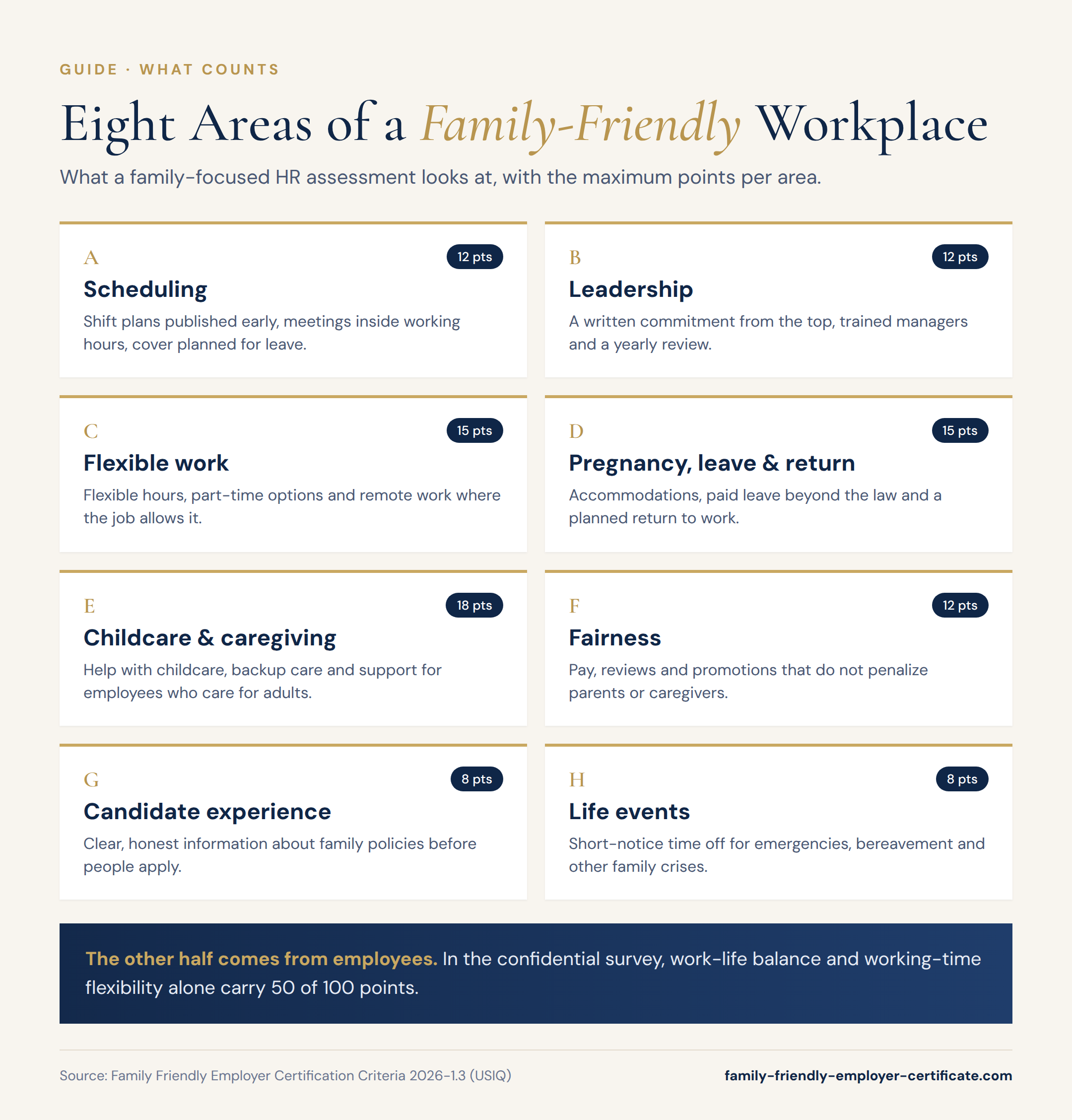
The Family Friendly Employer certification looks at eight areas in its family-focused HR assessment. They are a practical map of where family-friendliness shows up, and where it often breaks down. USIQ has also written about the family-friendly policies that matter most to employees.
1. Work organization and scheduling
For many families, predictability matters more than any single benefit. If the employer publishes shift plans two weeks ahead, parents can arrange childcare. Keep meetings and mandatory training inside agreed working hours. Then parents of young children do not have to choose between their job and the daycare pickup. This area also covers something often overlooked: cover for parental leave and short-notice absences. Without it, the rest of the team quietly carries the extra load.
2. Leadership and family-aware management
HR writes the policies, but managers decide how they work in everyday life. A family-friendly employer has a visible commitment from senior leadership and a named person responsible for it. Its managers also know how to handle requests for flexibility or leave. Without that, even good policies end up depending on luck: who your manager happens to be.
3. Flexible work and working-time models
Flexibility comes in many forms: flexible start and end times, part-time work, compressed weeks, job sharing and remote work for roles where it is possible. Not every job works from home, and a family-friendly employer does not pretend otherwise. It looks for the forms of flexibility that fit each kind of work, including shift and on-site roles.
4. Pregnancy, parental leave and return to work
This area runs from the first announcement of a pregnancy to the months after an employee comes back. It includes reasonable accommodations during pregnancy and paid leave beyond what the law requires. Our guide to building a paid parental leave policy shows how to set eligibility, weeks and pay. It also means contact during leave if the employee wants it. The return to work follows a plan, for example with reduced hours at first. Many careers stall not during leave but in the year after it.
5. Childcare, caregiving and family benefits
Childcare is one of the largest costs a young family faces. Child Care Aware of America put the national average price at $13,128 a year in 2024. Employers can help with subsidies, backup care, partnerships with local providers, a dependent care FSA or on-site care. Support for employees who care for adults belongs here too, from flexible leave to information about eldercare services.
6. Fairness and nondiscrimination for parents and caregivers
A family-friendly employer makes sure that using a family benefit does not lead to worse reviews, smaller raises or missed promotions. This is not only good practice. The U.S. Equal Employment Opportunity Commission has issued enforcement guidance on workers with caregiving responsibilities. It explains when unequal treatment of caregivers becomes unlawful discrimination, for example when decisions rest on stereotypes about working mothers.
7. Employer branding and candidate experience
Applicants should be able to find out what an employer offers before they apply, without having to raise sensitive questions in an interview. Clear information about leave, flexibility and childcare support on the careers page is part of being family friendly. So is a hiring process that never asks about family plans.
8. Life events, family emergencies and transitions
Families face events that do not fit a policy calendar. Think of a hospital stay, a death, a school closure, a divorce or a move to care for a parent. A quick, simple way to take short-notice time off on every shift often beats an extra week of vacation.
What U.S. law already requires
A family-friendly employer goes beyond the law, so it helps to know where the legal floor is. The main federal rules are these:
- Family and Medical Leave Act (FMLA): eligible employees of employers with 50 or more employees can take up to 12 weeks of unpaid, job-protected leave a year. Covered reasons include the birth of a child, a serious health condition and caring for a family member.
- Pregnant Workers Fairness Act (PWFA): since June 27, 2023, employers with 15 or more employees must provide reasonable accommodations. This covers known limitations related to pregnancy, childbirth or related conditions, unless the accommodation would cause undue hardship.
- PUMP for Nursing Mothers Act: employers must give nursing employees reasonable break time and a private space, other than a bathroom, to express breast milk for up to one year after birth. Employers with fewer than 50 employees can claim an exemption only if compliance would cause undue hardship.
On top of that, 12 states and the District of Columbia pay benefits through mandatory paid family and medical leave programs, and Maryland and Virginia have passed programs that are set to start paying in 2028. Many states and cities also have their own rules on sick leave, scheduling and pregnancy accommodations.
None of this makes an employer family friendly. It makes it compliant. The Family Friendly Employer criteria therefore give benefit credit only for what goes beyond federal, state and local requirements. The HR assessment is also not a legal audit, and it does not replace advice from an employment lawyer.
Why family-friendliness matters more in 2026
Two things have changed. More families depend on two incomes, and the gap between what employees want and what they get is easy to measure.
In a Pew Research Center survey of 2,242 working parents from March 2026, more than eight in ten parents who are not self-employed said paid parental, family or medical leave would be extremely or very helpful. Yet only about half had access to it. Seventy-one percent said the flexibility to choose when they work their hours would help a lot. Only a quarter said they had a great deal or a fair amount of it.
Employers have started to respond. The 2026 SHRM Employee Benefits Survey found that 46% of employers now offer paid parental leave, up from 39% a year earlier. Even so, the Bureau of Labor Statistics reports that only 49% of private-industry workers had access to paid family and medical leave in March 2026. The difference between the best and the average employer is still large, and candidates notice it. Our article on how family-friendly policies help you attract talent looks at this from the applicant’s side.
Family friendly does not only mean parents
It is easy to think of family-friendliness as a benefit for young parents. In reality, the group is much broader. Employees care for spouses after an illness, for parents with dementia, for adult children with disabilities, or for grandchildren. According to AARP and the National Alliance for Caregiving, six in ten family caregivers have a job. Half of them have had to go in late, leave early or take time off because of caregiving.
A family-friendly employer therefore writes its policies for caregivers in general, not just for new mothers. Good examples are leave that covers any close family member and flexible hours that do not require a child as a reason. Another is a culture that encourages fathers and partners to take parental leave instead of merely allowing it.
How candidates can tell a real family-friendly employer from a slogan
If you are weighing job offers, a few questions quickly separate substance from marketing:
- Is the policy written down and available before you apply, or only described in general terms?
- Does it apply to everyone, including part-time and hourly staff, or only to some groups?
- How many weeks of paid parental leave does the employer offer, and do fathers and partners actually take them?
- How far in advance does the employer publish schedules, and how often do they change at short notice?
- What happens to targets and bonuses during leave and in the months after it?
- Has an independent organization checked the claim, and can you verify the result yourself?
The last point is where a certificate helps. A seal is only useful if candidates can check what the assessment measured and who did the measuring.
How Family Friendly Employer certification works
The Family Friendly Employer certificate, issued by USIQ, combines two perspectives with equal weight. The employee survey invites every employee on the U.S. payroll to answer 46 standard questions in about 8 to 10 minutes. Forty-two of them count toward the score. Two items alone, on work-life balance and working-time flexibility, carry half of the survey points. The survey never asks about pregnancy, children or family status.
The HR assessment covers 39 family-focused criteria in the eight areas described above. A trained reviewer rates each criterion three ways: the offer itself, who can use it and how it works in practice. The lowest of the three ratings counts. A policy that exists on paper but is out of reach for most employees cannot earn full points.
Both parts are worth up to 100 points. An employer needs at least 120 of 200 points for Certified, 140 for Silver, 160 for Gold and 180 for Platinum. It must also meet minimums in each part. That way, a strong result in one part cannot hide a weak result in the other. The certificate is valid for 24 months, and anyone can check a seal on a public verification page. You will find the full rules in our methodology and in the published certification criteria. The sample report shows what an employer receives at the end. The pricing page lists the four packages.
If you want to know how to prepare, our step-by-step preparation guide walks through the process. Smaller companies will find answers to their specific questions in our guide to certification for small businesses.
Frequently asked questions
Is “family-friendly employer” a legal status?
No. There is no legal definition in the United States and no official register. Employers can describe themselves this way without any check, which is why independent certification with published criteria is useful.
Do you need expensive benefits to be family friendly?
Not necessarily. Predictable schedules, fair treatment of people who use flexibility and a quick process for family emergencies cost little. Employees value them highly. Paid leave and childcare support carry more weight, but they are only part of the picture.
Does family friendly only concern employees with children?
No. Family-friendly policies should cover everyone with caring responsibilities, including employees who look after a partner, a parent or another relative.
How long is the Family Friendly Employer certificate valid?
Twenty-four months from the date of issue. After that, the employer can take part in a new assessment, and the results show whether things have improved.

About the author
PhDr. Oliver Scharfenberg, MBA
Oliver Scharfenberg sits on the Scientific Advisory Board of USIQ, which issues the Family Friendly Employer certificate. His doctoral thesis (2024) analyzed employer seals and included a randomized experiment with 1,093 participants on how a seal changes the way applicants react to a job ad. He previously served as a lay judge on the commercial chamber of the Regional Court of Berlin, hearing unfair competition cases, and is CEO of Syntharis Group.
Next step
Show Candidates How Work and Family Fit
The Family Friendly Employer (USIQ) certificate combines a confidential employee survey with a family-focused HR assessment against 39 published criteria. One-time packages start at $2,990.
About half of U.S. private-sector workers still lack paid family and medical leave. How to set eligibility, weeks and pay, treat every parent equally, coordinate with state programs and use the permanent 45S credit.
Child care costs keep rising while few workers get any help from their employer. Here is what U.S. companies can offer, which tax rules changed in 2026, and how to measure results.
How small businesses can become family friendly without a big benefits budget: the rules that apply at your size, low-cost measures, federal tax credits and how certification works for teams of ten or more.