
Ask a recruiter which candidates are hardest to win, and many will describe the same person. They are experienced and in demand, with young children or an aging parent at home. Usually they already work somewhere that treats them reasonably well. That person is not looking for a slightly higher salary. They want a job that still works when the school calls at 11 a.m., and that is what family-friendly policies have to deliver.
For U.S. employers, this group is large and growing, and few employers serve it well. This article looks at the numbers behind it and explains which family-friendly policies make the biggest difference to candidates. It also shows how to present them so that people believe you. It complements our overview of what a family-friendly employer is.
The talent pool that depends on family-friendly policies
Working parents are not a niche. According to the Bureau of Labor Statistics, 73.9% of mothers and 93.7% of fathers with children under 18 were in the labor force in 2025. The gap is widest where childcare is hardest to arrange. Among parents whose youngest child was under six, 68.0% of mothers were in the labor force, compared with 95.3% of fathers.
That gap is a reserve of skilled people, many of whom would work more, or work at all, if the conditions fit. Bright Horizons’ Modern Family Index 2025 found that 58% of working parents had considered a career break because of childcare availability and access. The Harris Poll ran the survey.
Caregiving for adults adds another large group. The Caregiving in the US 2025 report by AARP and the National Alliance for Caregiving counts 63 million family caregivers, about a quarter of all adults. Of these, 29% care for children and adults at the same time. Six in ten caregivers are employed, and half of those say caregiving has made them arrive late, leave early or take time off. Many of these employees will change jobs for an employer that makes their life manageable. And the competition for them is unlikely to ease. USIQ’s analysis of the U.S. labor shortage in 2027 expects shortages to persist in fields such as health care, manufacturing and the skilled trades.
What candidates want, and what they get
The clearest picture of the gap comes from a Pew Research Center survey of 2,242 working parents, conducted in March 2026.
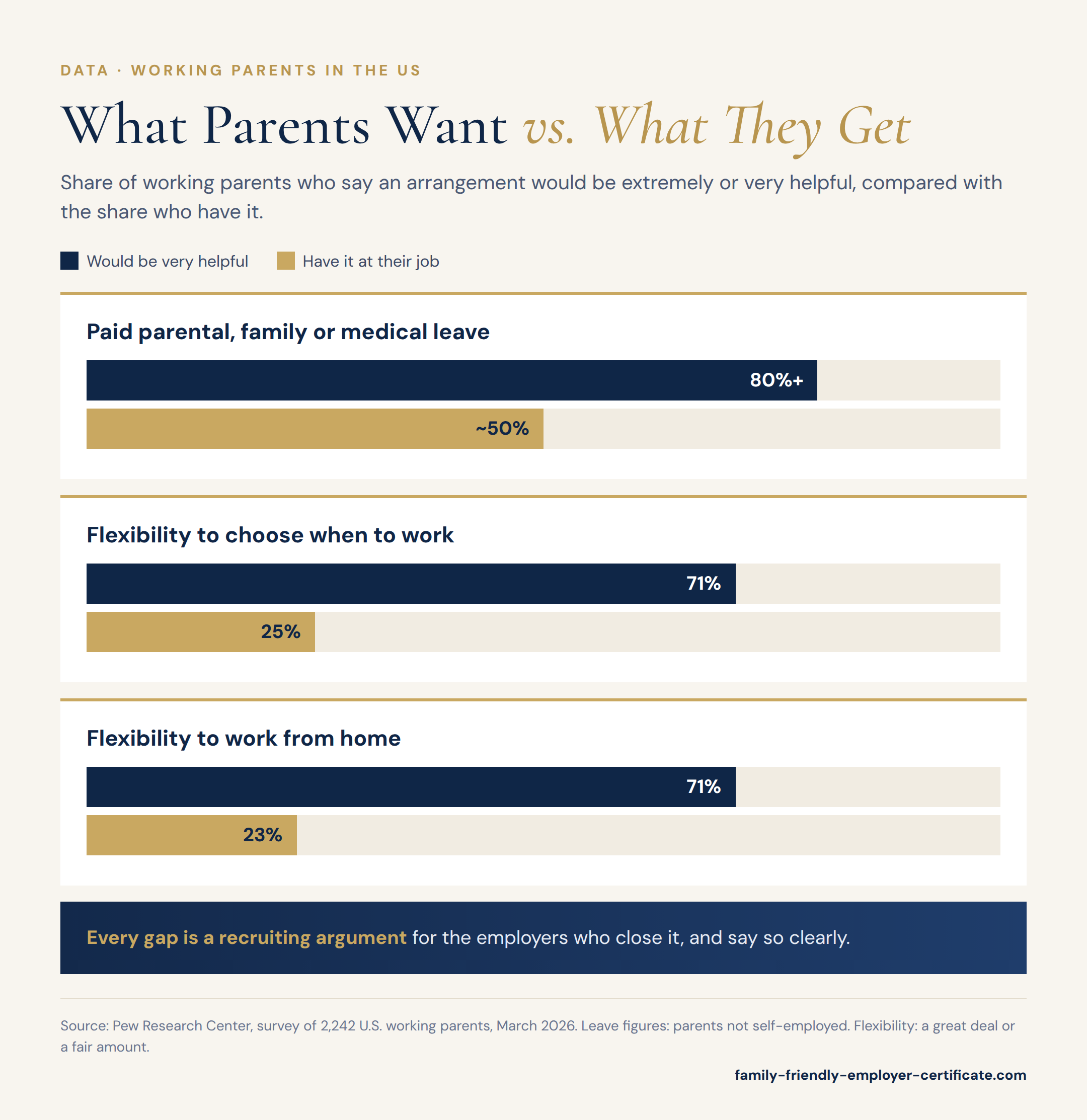
More than eight in ten parents who are not self-employed said paid parental, family or medical leave would be extremely or very helpful. Only about half had it. Seventy-one percent said the same about flexibility to choose when they work their hours. Yet only 25% had a great deal or a fair amount of it. The pattern is the same for working from home: 71% said it would help, 23% said they had much flexibility to do it.
The gap is not the same for everyone. Among parents who are not self-employed, 70% of those with upper incomes had paid leave, compared with 33% of those with lower incomes. Lower-income parents were also far more likely to worry about losing pay if they had to stay home with a sick child. For employers who hire hourly and shift workers, this is an opportunity. In these jobs, a modest and reliable family policy stands out far more than in salaried roles. Those roles often offer flexibility already.
Why family support pays off
Family-friendly policies cost money, and it is fair to ask what they bring back. The research points to three effects: easier hiring, better retention and fewer disruptions.
Hiring
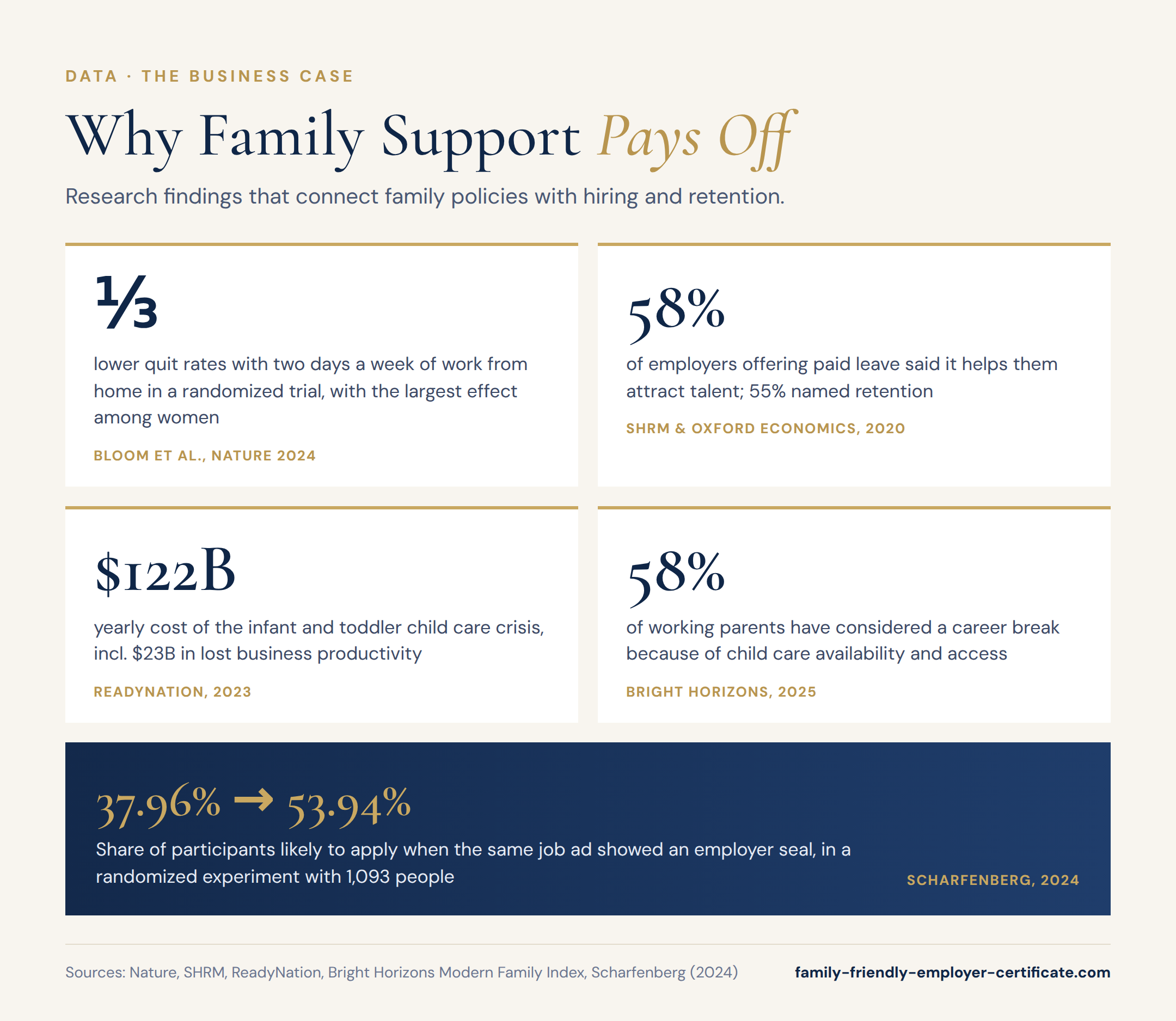
Employers that offer paid leave see it as a recruiting tool. In a study by SHRM and Oxford Economics published in 2020, 58% of employers offering paid leave said it helped them attract talent. Since then, paid parental leave has spread further. The 2026 SHRM Employee Benefits Survey found that 46% of employers offer it, up seven points in a year. As more competitors add it, not offering it becomes a disadvantage that candidates notice.
Retention
Flexibility has measurable effects on turnover. In a randomized trial with 1,612 employees published in Nature in 2024, Nicholas Bloom and colleagues tested hybrid work. Working from home two days a week reduced quit rates by one-third without damaging performance. The reduction was significant for women, non-managers and employees with long commutes. The study took place at a technology company in China, so the exact figure will not transfer to every workplace. The direction is clear, though: flexibility keeps people who would otherwise leave. USIQ looks at this in more detail in its article on the benefits of remote workers for employers.
The same SHRM and Oxford Economics study found that 55% of employers offering paid leave saw benefits for retention. That matters most in the months after a birth, when many careers are decided. An employee who returns to a planned, phased start is much more likely to stay. Compare that with coming back to a full inbox and a manager who has moved on.
Fewer disruptions
When care breaks down, work suffers. ReadyNation estimated in 2023 that the infant and toddler childcare crisis costs the U.S. economy $122 billion a year. That includes $23 billion in lost productivity for businesses. Backup care, predictable schedules and a simple process for family emergencies reduce exactly the kind of last-minute absences that drive these costs.
Which family-friendly policies candidates notice most
Not every benefit carries the same weight in a hiring decision. Based on the data above, five areas matter most to candidates with family responsibilities:
- Flexibility that fits the job. Flexible hours, part-time options and remote work where possible. For shift roles: schedules published well in advance and the ability to swap shifts.
- Paid leave beyond the legal minimum. For all parents, including fathers, partners and adoptive parents, and for caring for other family members. Federal law only guarantees unpaid FMLA leave, and only for eligible employees of employers with 50 or more staff.
- Help with childcare. From a dependent care FSA and backup care to subsidies or reserved places. With a national average price of $13,128 a year in 2024, according to Child Care Aware of America, even partial support is noticeable. Our guide to child care support and the new 2026 tax rules compares the options.
- A planned return to work. Phased hours, adjusted targets and a manager who has planned for it.
- Fair careers. Evidence that people who use these policies still get raises and promotions.
The last point is the hardest to show and often the most important. Candidates have heard about employers whose policies look generous on paper and whose managers quietly penalize anyone who uses them. Our step-by-step guide on how to become a Family Friendly Employer explains how to build all five areas. Our guide for small businesses shows what is possible on a small budget.
Make the offer visible
Even good policies attract nobody if candidates cannot find them. Three rules help:
- Be specific. “We support working parents” says nothing. “Sixteen weeks of fully paid leave for every new parent, schedules published two weeks ahead, and backup childcare for up to ten days a year” says a great deal. Candidates can also compare it.
- Put it where decisions are made. On the careers page next to the open roles, in a short line in every job ad, and in the material interviewers hand out.
- Raise it yourself. Many candidates will not ask about parental leave or flexibility in an interview because they fear it will count against them. Interviewers should mention the policies before candidates ask, and they should never ask candidates about their own family plans.
Why candidates doubt claims, and how proof helps
Almost every careers page claims a family-friendly culture, so candidates have learned to discount it. They read employee reviews, ask people they know, and look for signs that the claims are real. An independent seal can shorten that search, provided candidates can check it.
Research supports this. In a randomized experiment by PhDr. Oliver Scharfenberg with 1,093 participants, the share of people who said they would likely apply rose from 37.96% to 53.94% when the same job ad carried an employer seal. The study tested a German seal, so it shows how applicants react to a seal in general, not the effect of a particular program.
The Family Friendly Employer certificate lets anyone check the result. Every employee on the U.S. payroll receives an invitation to a confidential survey. In it, work-life balance and working-time flexibility carry half of the points. An HR assessment then checks 39 family-focused criteria against evidence, rating the offer, who can use it and how it works in practice. Our methodology publishes the criteria, weights and thresholds. Every seal links to a public verification page with the tier, the covered locations and the exact dates. Our guide on how to use your Family Friendly Employer seal shows where it reaches candidates and how to describe it accurately.
Common mistakes when promoting family-friendliness
Employers that do a lot for families still lose candidates because of how they present it. These are the mistakes we see most often:
- Photos instead of facts. A picture of a parent with a laptop on the sofa does not tell anyone how many weeks of paid leave there are.
- Unclear scope. If a benefit only applies to salaried staff or to one location, say so. Candidates who find out later feel misled, and they tell others.
- Promises the hiring manager does not keep. If the careers page offers flexible hours and the hiring manager says “not in this team”, the candidate will believe the manager. Brief everyone who interviews.
- Policies only after the offer. Many candidates decide whether to apply at all based on what they can see in advance. Publish the essentials openly instead of in an internal portal.
- “Family” meaning only mothers. Fathers, partners and adult caregivers read the same pages. Policies and wording that include them reach more people.
- Old information. An outdated benefits page or an expired seal damages trust more than a short, current one.
How to measure the effect on recruiting
To find out whether your family policies help you hire, track a few figures before and after you change or publish them:
- applications per opening, especially for roles that are hard to fill;
- offer acceptance rates, and the reasons candidates give for declining;
- the share of applicants who name flexibility or family benefits as a reason to apply;
- return and retention rates after parental leave, one year on;
- results on the two family questions in your employee survey over time.
These numbers show leadership what the policies are worth, and they show you which parts of your offer candidates actually value.
Frequently asked questions
Are family-friendly policies only relevant for attracting women?
No. Fathers use parental leave when it is paid. Research on California’s paid family leave program found that fathers of infants were 46% more likely to be on leave once the program was available. Caregiving for adults also affects employees of every gender. Policies that are open to all parents and caregivers also avoid reinforcing the idea that care is mainly a women’s issue.
We cannot match the benefits of large employers. Is it still worth it?
Yes. Predictable schedules, flexibility that fits the work and a simple process for family emergencies cost little and rank high with candidates. Clear communication of what you do offer is often more effective than a long list of benefits.
How quickly will we see an effect?
You can start measuring application numbers as soon as your job ads and careers page change. Effects on retention take longer, so measure them over a year or more.
Does a seal replace good policies?
No. A credible seal confirms that policies exist and work in practice. Without them, an employer would not reach the thresholds. Details on the packages are on our pricing page.

About the author
PhDr. Oliver Scharfenberg, MBA
Oliver Scharfenberg sits on the Scientific Advisory Board of USIQ, which issues the Family Friendly Employer certificate. His doctoral thesis (2024) analyzed employer seals and included a randomized experiment with 1,093 participants on how a seal changes the way applicants react to a job ad. He previously served as a lay judge on the commercial chamber of the Regional Court of Berlin, hearing unfair competition cases, and is CEO of Syntharis Group.
Next step
Show Candidates How Work and Family Fit
The Family Friendly Employer (USIQ) certificate combines a confidential employee survey with a family-focused HR assessment against 39 published criteria. One-time packages start at $2,990.
Child care costs keep rising while few workers get any help from their employer. Here is what U.S. companies can offer, which tax rules changed in 2026, and how to measure results.
What makes an employer family friendly? The eight areas that count, where U.S. law sets the floor, current data on working families, and how certification checks the claim.
How small businesses can become family friendly without a big benefits budget: the rules that apply at your size, low-cost measures, federal tax credits and how certification works for teams of ten or more.