
Small businesses rarely lose candidates because of the work itself. They lose them over the parts of the offer that are hard to compare. Will I be able to leave early when my daughter is sick? What happens when the baby comes? Large employers answer these questions with glossy benefit pages. A company with 25 people usually answers them in the interview, if at all. That holds even for a truly family friendly small business.
That is a missed opportunity. Small employers often treat families better than their reputation suggests. The owner knows everyone by name, and people sort things out person to person. The problem is that nobody outside the company can see it. This guide explains what family-friendliness means at a small scale and which rules apply at your headcount. It covers low-cost measures and the federal tax credits for bigger ones. It also shows how certification works for teams of ten or more employees.
Why small employers have more to gain than they think
According to the SBA Office of Advocacy, the United States has 36.2 million small businesses, and they employ 45.9% of all U.S. employees. Most of them compete with much larger organizations for the same nurses, technicians, accountants and drivers. They usually cannot win on salary alone.
Family-friendliness is one of the few areas where a small company can compete on equal terms, and often with an advantage. Large organizations need formal programs because managers cannot know every employee. A small employer can answer a shift change request in a day. It can solve a school closure problem in an hour. And it can make sure a returning parent does not drown in work during the first week back. Those are exactly the things working parents say they need most. In a Pew Research Center survey from March 2026, 71% of working parents said flexibility in when they work their hours would be extremely or very helpful. Only a quarter said they had a great deal or a fair amount of it.
The catch is that informal flexibility is invisible and fragile. It depends on one person’s goodwill and exists nowhere in writing. New employees only learn about it after they join. Turning it into something reliable and visible is most of the work. For the visibility part, USIQ’s overview of employer branding tools for companies with 10 to 250 employees is a useful companion.
The legal baseline at your size
Before planning anything voluntary, it helps to know which federal rules already apply. Most family-related federal laws use headcount thresholds, and some of them are lower than many small businesses expect.
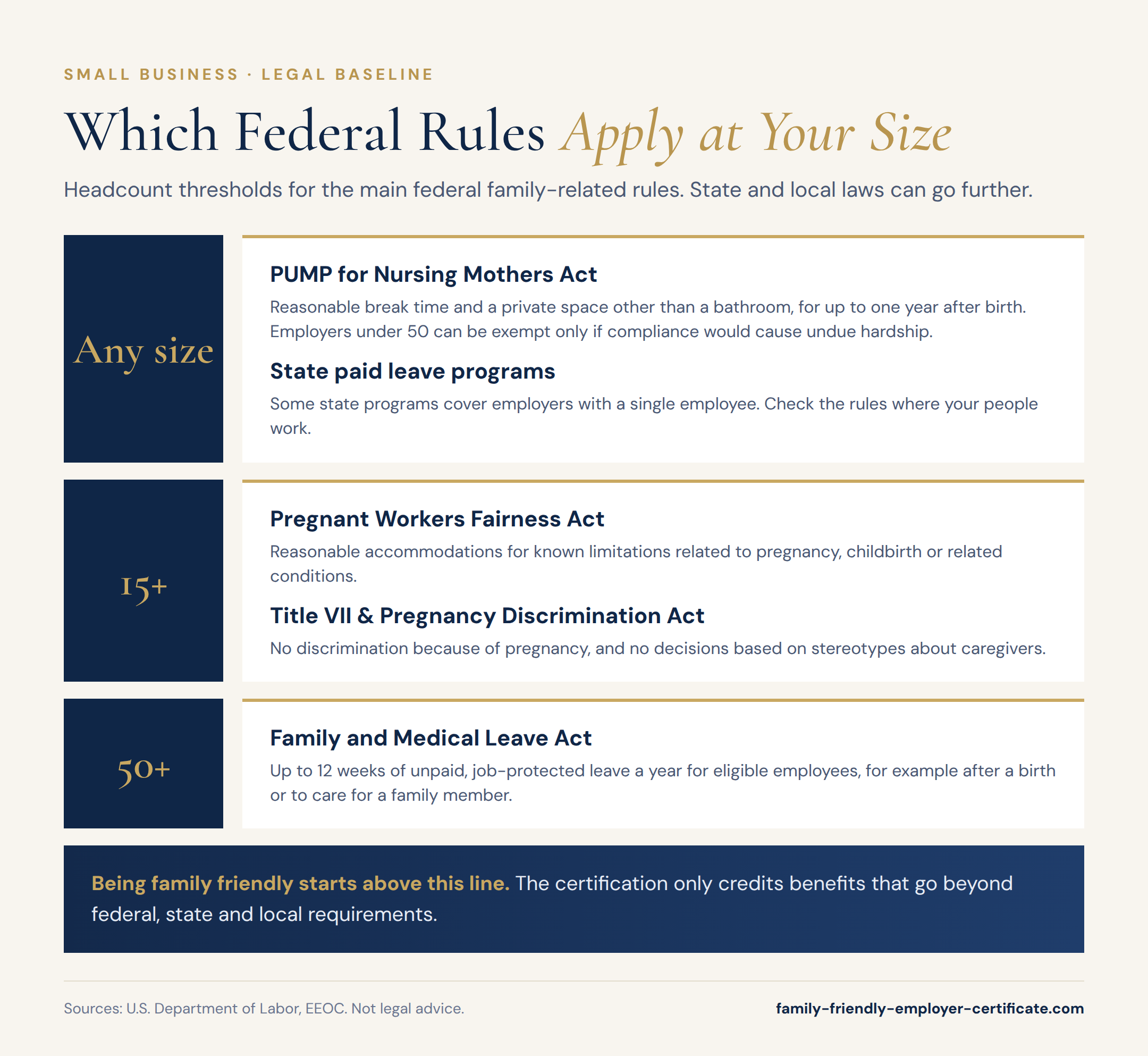
- Any size: the PUMP for Nursing Mothers Act requires reasonable break time and a private space, other than a bathroom, to express breast milk. This applies for up to one year after a child’s birth. Employers with fewer than 50 employees can claim an exemption only if compliance would impose an undue hardship. The Department of Labor has said that this applies only in limited circumstances.
- 15 or more employees: the Pregnant Workers Fairness Act requires reasonable accommodations for known limitations related to pregnancy, childbirth or related medical conditions. The EEOC lists examples such as additional breaks, the option to sit or stand, and time off for health care appointments. Title VII, including the Pregnancy Discrimination Act, also applies from 15 employees.
- 50 or more employees: the Family and Medical Leave Act gives eligible employees up to 12 weeks of unpaid, job-protected leave a year. Employees generally qualify after 12 months and 1,250 hours of work at a site with at least 50 employees within 75 miles.
State rules that reach small business owners
State law can reach much smaller employers. Minnesota’s paid family and medical leave program, for example, started on January 1, 2026. It applies to employers with one or more employees in the state. Paid sick leave and scheduling laws also vary by state and city. If your employees work in several states, the rules of each state where they work apply. It is worth checking with an employment lawyer or your payroll provider.
This matters for certification too. The Family Friendly Employer criteria give benefit credit only for what goes beyond federal, state and local requirements. Paying into a mandatory state program is compliance, not a family benefit.
Where a small business falls behind, and where it leads
On formal benefits, size makes a clear difference. SHRM’s 2025 Employee Benefits Survey, presented to a House subcommittee in February 2026, found that 35% of small organizations with 1 to 99 employees offered paid parental leave. Among large organizations the figure was 46%, and among extra-large ones 66%. Paid family leave follows a similar pattern, with availability rising as organizations grow.
On everyday practice, the typical small business often does better. Shorter decision paths, personal relationships and a clear view of who covers for whom make flexibility easier to grant. The Family Friendly Employer FAQ notes the same pattern: small employers often do well on flexibility and short-notice time off, even without large benefit budgets.
So the sensible strategy for a small business is not to copy a big company’s benefits package. It is to make the strengths reliable, add one or two targeted benefits, and document all of it.
Family-friendly measures that cost little
Many of the practices that employees value most are a matter of organization rather than money.
Publish schedules early
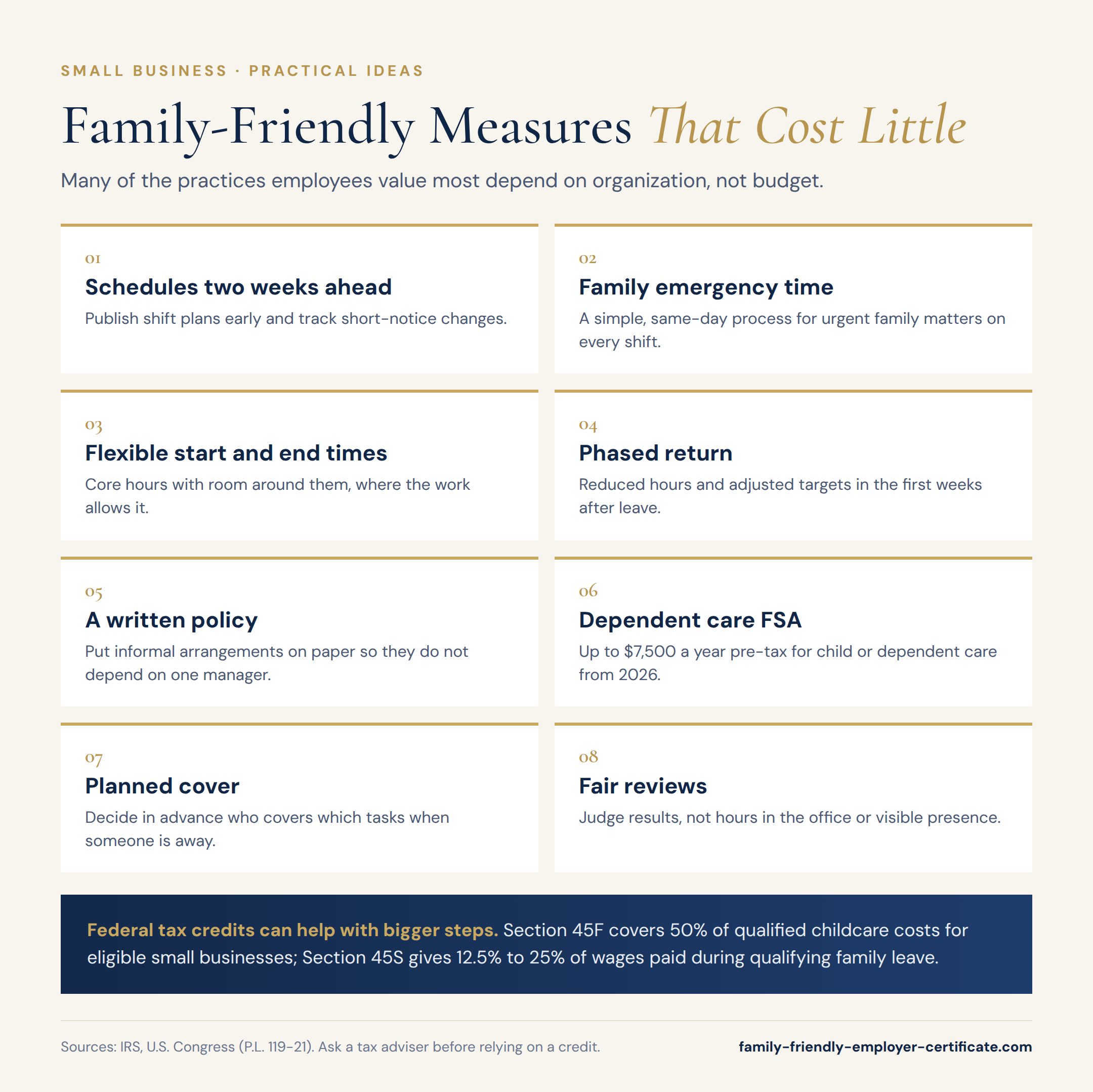
Shift workers with children cannot arrange care for a shift they learn about the evening before. Publishing schedules at least 14 days ahead and tracking short-notice changes is one of the most valuable things a small business can do. It costs nothing but planning.
Create a simple process for family emergencies
Decide how someone takes time off at short notice when a child is sick or a parent goes to the hospital. Settle whom they call, who covers the shift and whether the time is paid. The process should work for every shift, including nights and weekends, not just for office staff.
Offer flexibility that fits the work
Not every job works from home, but almost every job allows some flexibility. Options include core hours with a flexible start, swapping shifts within the team, a compressed week or a part-time option. The aim is to find a version that works for each role, rather than offering flexibility only to people at a desk.
Plan the return from leave
Careers often stall in the months after parental leave, not during it. A phased return makes a large difference and costs little. Think of reduced hours, adjusted targets and a short conversation before the first day back.
Write it down
Informal arrangements disappear when a manager leaves or the business grows. A two-page family policy that describes flexibility, emergency time off and leave protects employees. It also makes the company’s offer visible to applicants. It is also the first piece of evidence a certification reviewer will ask for.
Use the dependent care FSA
If you run a cafeteria plan, a dependent care flexible spending account lets employees pay for childcare and other dependent care with pre-tax dollars. Under the One Big Beautiful Bill Act, the annual limit rose from $5,000 to $7,500 starting January 1, 2026. It was the first increase since 1986. Employers must amend their plan documents to allow the higher amount. Our guide to employer child care benefits explains the testing rules and other options.
Plan cover and judge results fairly
Decide in advance who covers which tasks when someone is on leave, so that colleagues are not quietly overloaded. And base reviews and raises on results, not on who stays latest. The EEOC’s guidance on workers with caregiving responsibilities explains how decisions based on stereotypes about caregivers can become unlawful discrimination.
Federal tax credits for bigger steps
Two federal credits can lower the cost of the more expensive measures. The One Big Beautiful Bill Act expanded both. Both also come with detailed conditions, so talk to a tax adviser before you rely on them.
- Employer-provided childcare credit (Section 45F): for amounts paid after December 31, 2025, the credit equals 40% of qualified childcare expenditures, or 50% for eligible small businesses, plus 10% of childcare resource and referral costs. Qualified expenses can include contracting with a licensed childcare program, not only building a center. The annual cap is $500,000, or $600,000 for eligible small businesses.
- Paid family and medical leave credit (Section 45S): the credit is now permanent. It ranges from 12.5% to 25% of wages paid to qualifying employees for up to 12 weeks of family and medical leave per year. Since 2026, employers that insure the benefit can also calculate the credit based on the premiums they pay. Leave required by state law does not count.
For a small business, the 45S credit in particular can make a modest paid leave policy much cheaper than it first appears. Think of four to six weeks at partial pay.
How certification works for a small business
Employers with 10 or more U.S. employees can apply for the Family Friendly Employer certificate. The process is the same as for large companies, but the requirements scale with the size of the workforce.
The employee survey goes to everyone on the U.S. payroll and stays open for 14 days. For employers with 10 to 39 employees, at least 50% must take part, with at least five completed surveys. A company with 39 employees therefore needs 20 responses. The two family questions, on work-life balance and on working-time flexibility, carry half of the survey points. In a small company, these two answers often reflect the owner’s everyday decisions more directly than any written policy.
The HR assessment covers 39 criteria in eight areas. Some may not fit a very small business, for example criteria on several locations. Marking a criterion “not applicable” requires a documented reason and approval. At least half of the criteria in each area must remain applicable. Lacking a practice is never a reason on its own.
Many small business owners worry about paperwork. You do not need a large HR system. Reviewers accept redacted extracts and aggregate records. Examples are a one-page policy, an example schedule or a short list of approved flexibility requests. What counts is that the evidence shows the practice exists and is available to most employees. Full credit needs access for at least 80% of the covered workforce.
The certification costs a one-time fee, starting at $2,990 for the Basic package. If USIQ issues no award, you get everything except the $990 survey fee back within 14 days. You still receive your survey results. The details are on the pricing page, and our methodology sets out the full scoring rules.
A 90-day plan for your small business
If you want to apply within a quarter, this sequence works well for teams of 10 to 100 people:
- Weeks 1 to 3: Take stock. List what you already do for families, even informally. Read the published criteria and mark where you have evidence and where you do not.
- Weeks 4 to 6: Write it down. Turn informal arrangements into a short family policy. Decide on schedule notice, emergency time off and the return from leave.
- Weeks 7 to 9: Talk to your people. Tell managers and employees what the policy says and make sure it applies to every shift and location. Fix the most obvious gaps first, often scheduling and cover.
- Weeks 10 to 13: Apply. Order the assessment, share the survey invitation with every employee and collect your documents for the HR assessment.
Our step-by-step guide on how to become a Family Friendly Employer covers each stage in more detail. If you are new to the topic, start with our overview of what a family-friendly employer is. Small employers with operations in Europe will find the German and Austrian programs on our Family Friendly Employer overview page.
Frequently asked questions
Is there a minimum company size?
Yes. Employers need at least 10 employees in the United States. Below that, the survey cannot produce reliable, anonymous results.
Do we need paid parental leave to be certified?
No single benefit is mandatory. However, the three core areas, flexible work, parental leave and return, and family benefits, have minimum scores that rise with each tier. An employer with nothing to offer in leave or family benefits will find it hard to reach even the Certified tier.
Our state already has a paid family leave program. Does that count?
Only what you offer beyond the state program counts as a benefit. Examples are topping up the state benefit to full pay or offering more weeks.
Can a small company reach Platinum?
Yes. The thresholds and minimums are the same for every employer, whatever its size. A small business with strong flexibility, fair treatment and a few well-chosen benefits can score highly in both parts.

About the author
PhDr. Oliver Scharfenberg, MBA
Oliver Scharfenberg sits on the Scientific Advisory Board of USIQ, which issues the Family Friendly Employer certificate. His doctoral thesis (2024) analyzed employer seals and included a randomized experiment with 1,093 participants on how a seal changes the way applicants react to a job ad. He previously served as a lay judge on the commercial chamber of the Regional Court of Berlin, hearing unfair competition cases, and is CEO of Syntharis Group.
Next step
Show Candidates How Work and Family Fit
The Family Friendly Employer (USIQ) certificate combines a confidential employee survey with a family-focused HR assessment against 39 published criteria. One-time packages start at $2,990.
About half of U.S. private-sector workers still lack paid family and medical leave. How to set eligibility, weeks and pay, treat every parent equally, coordinate with state programs and use the permanent 45S credit.
Child care costs keep rising while few workers get any help from their employer. Here is what U.S. companies can offer, which tax rules changed in 2026, and how to measure results.
What makes an employer family friendly? The eight areas that count, where U.S. law sets the floor, current data on working families, and how certification checks the claim.