
A new baby, an adoption or a foster placement is one of the few life events an employer can see coming months in advance. Yet many U.S. companies still handle it case by case: a manager negotiates a few weeks, HR checks what the law requires, and the employee pieces together vacation days, short-term disability and unpaid time. The result is uneven treatment, nervous employees and avoidable legal risk.
A written paid parental leave policy fixes most of that. It tells every employee what they can count on, gives managers a plan they can staff around, and lets you coordinate your benefit with federal law, state programs and a tax credit that Congress made permanent in 2025. This guide walks through the rules that set the floor, the eight design decisions that shape any policy, what it really costs, and how to make sure people actually use the leave you offer.
Why a written policy matters more in 2026
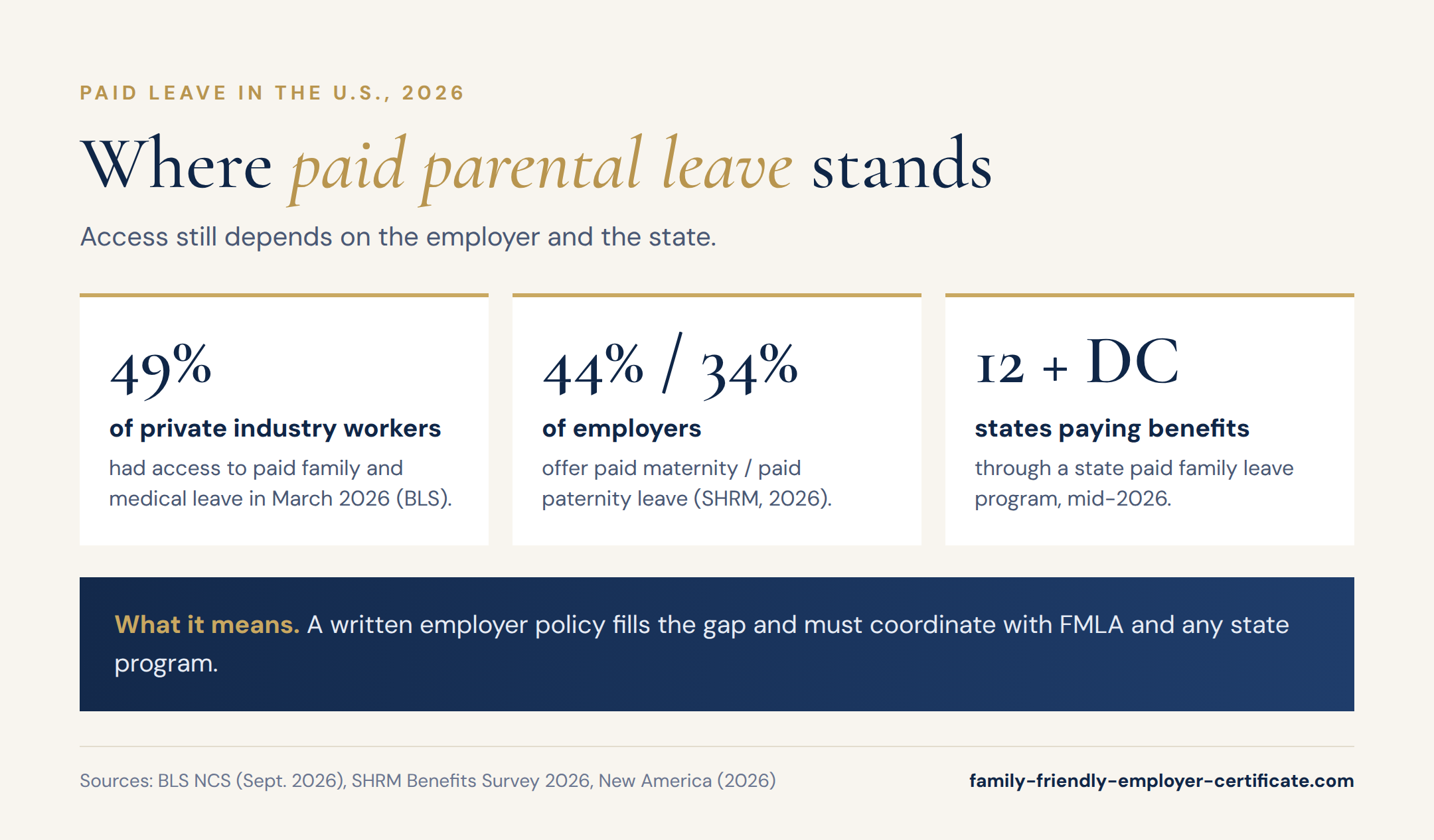
The United States still has no national paid leave program, so access depends on where people work and live. According to the Bureau of Labor Statistics, 49 percent of private industry workers had access to paid family and medical leave in March 2026, compared with 81 percent who had paid sick leave. About half the private workforce, in other words, faces a birth or adoption without a paid option from work.
Employer practice is moving, but slowly and unevenly. SHRM’s 2026 Employee Benefits Survey found that 44 percent of employers offer paid maternity leave and 34 percent offer paid paternity leave, both up from 2025. That ten-point gap between mothers and fathers matters, and we come back to it below because it is also a legal issue.
Meanwhile, the share of families that depend on two paychecks is high. BLS reports that in 2025, both parents were employed in 66.3 percent of married-couple families with children, and 68.0 percent of mothers with children under six were in the labor force. When a child arrives, most households have no stay-at-home partner to absorb the shock. A clear policy is often the deciding factor in whether a valued employee comes back.
What U.S. law already requires
Before you design anything, map the legal floor. Your policy sits on top of it, and in some states it has to coordinate with a state benefit.
The FMLA: job protection, not pay
The Family and Medical Leave Act applies to private employers with 50 or more employees in 20 or more workweeks of the current or previous year. Eligible employees, meaning those with at least 12 months of service, 1,250 hours in the past year and 50 coworkers within 75 miles, can take up to 12 workweeks of job-protected leave for the birth of a child and bonding within the first year. Group health coverage continues on the same terms. The FMLA does not require pay. Your paid policy usually runs at the same time as FMLA leave, and the policy should say so in writing.
State paid family leave programs
As of mid-2026, 12 states and the District of Columbia pay family leave benefits through a state program: California, New Jersey, Rhode Island, New York, Washington, Massachusetts, Connecticut, Oregon, Colorado, Delaware, Minnesota and Maine. Delaware and Minnesota began paying benefits on January 1, 2026, and Maine on May 1, 2026. Maryland’s program is scheduled to start paying in 2028, and Virginia enacted a program in 2026 that is also set to begin in 2028.
These programs replace part of an employee’s wages up to a weekly cap, funded by payroll contributions. They are not a substitute for an employer policy, but they change its math. In a state program, your policy often works as a “top-up” that brings pay closer to 100 percent of salary. Multi-state employers need a policy that states the minimum everywhere and explains how it interacts with each state benefit.
Pregnancy accommodations and nursing breaks
Two other federal laws shape the period around leave. The Pregnant Workers Fairness Act, in effect since June 27, 2023, requires employers covered by Title VII (generally those with 15 or more employees) to provide reasonable accommodations for known limitations related to pregnancy, childbirth or related medical conditions, unless that causes undue hardship. Leave, schedule changes and telework are all on the EEOC’s list of possible accommodations.
The PUMP for Nursing Mothers Act extended the Fair Labor Standards Act so that most nursing employees get reasonable break time and a private space other than a bathroom to express milk for one year after the child’s birth. A return-to-work plan that ignores this is incomplete.
The eight decisions behind every paid parental leave policy
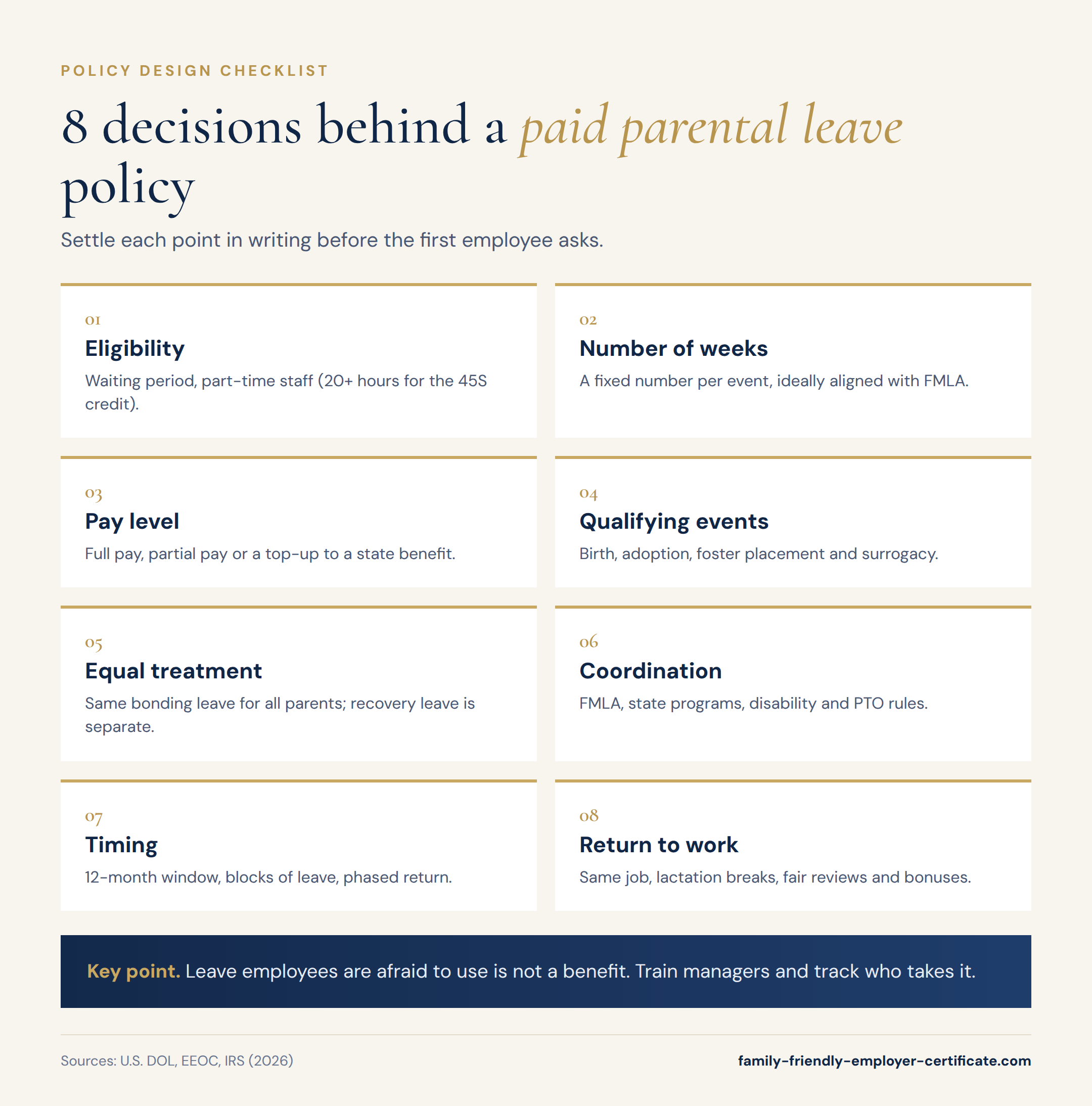
Most published templates jump straight to “how many weeks.” The number matters, but it is only one of eight choices, and the others decide whether the policy is fair, legal and usable.
1. Who is eligible
Decide whether leave starts on day one or after a waiting period, and whether part-time employees qualify. A short waiting period is common, but long ones exclude exactly the early-career employees most likely to start families. If you want the federal tax credit, note that it requires prorated leave for part-time employees who work 20 or more hours a week.
2. How many weeks
Outside the state programs, no law sets a minimum number of paid weeks. One practical anchor is the 12 weeks of FMLA job protection, so that pay and protection end together. A smaller company might start with four to six paid weeks and extend the benefit once it knows the real cost. Whatever you pick, define it as a set number of weeks per qualifying event, not “up to,” which invites inconsistent approvals.
3. How much pay
Full pay is simplest to explain. Partial pay (for example, 60 or 70 percent) stretches a budget across more weeks but discourages lower earners from taking the time. If you operate in a state with a program, decide whether you pay a top-up to 100 percent or a fixed employer benefit on top of the state check.
4. Which events qualify
Cover birth, adoption and foster placement on equal terms. Many employers also name surrogacy explicitly. Families formed through adoption face the same bonding needs and often less notice, so a policy limited to birth sends the wrong signal.
5. Equal treatment for all parents
This is where many policies go wrong. The EEOC distinguishes medical leave for pregnancy and childbirth recovery, which can be limited to the person who gave birth, from bonding leave, which must be provided to similarly situated men and women on the same terms. In 2018, Estée Lauder agreed to pay $1.1 million to settle an EEOC lawsuit after its policy gave new fathers two weeks of paid bonding leave and new mothers six. The fix is a two-part structure: a recovery period for the birthing parent, followed by the same bonding leave for every parent. Labels like “primary” and “secondary” caregiver can also create risk if, in practice, they track sex.
6. How it coordinates with other benefits
Spell out the order: short-term disability or a state medical benefit during recovery, then bonding leave, with your paid policy running alongside FMLA. Say whether employees must use vacation or sick days first. Forcing people to drain their PTO before parental pay starts is legal in many cases, but it leaves new parents with nothing for a child’s first ear infection.
7. When and how leave can be taken
Set a window, typically within 12 months of the birth or placement. Decide whether leave can be split into blocks or taken as a phased return with reduced hours. Flexibility costs little and helps both sides: a parent who returns at three days a week for a month often stays, while one forced back full time may not.
8. What happens on return
Address the job the employee returns to, lactation space and breaks, schedule flexibility for the first weeks, and how performance reviews and bonuses treat time on leave. Employees watch this part closely. A policy that protects the paycheck but quietly stalls a career is not family friendly.
What a paid parental leave policy costs
The direct cost is the wages paid during leave. A simple way to estimate it: multiply the expected number of new parents per year by average weekly pay and the number of paid weeks. For an employee earning $60,000 a year, eight weeks at full pay costs about $9,200. Indirect costs include temporary cover or overtime, but these often exist whether you pay the leave or not, because people take time off for a birth either way.
The more useful comparison is replacement. When a trained employee quits after a birth, you pay for recruiting, onboarding and lost productivity. The best-known employer survey on this comes from California, which has had a state program since 2004. In a study of 253 employers, researchers Eileen Appelbaum and Ruth Milkman found that 91 percent reported a positive or no noticeable effect on profitability and 93 percent on turnover, with smaller firms reporting more positive outcomes than large ones. The data are from 2011 and from a single state, so treat them as a signal rather than a forecast.
The federal 45S tax credit is now permanent
The employer credit for paid family and medical leave under Section 45S became permanent through the 2025 tax law, which the IRS calls the Working Families Tax Cuts. According to the IRS guidance from August 2026, the credit ranges from 12.5 to 25 percent of wages paid during up to 12 weeks of leave per year. Starting in 2026, employers can also claim it on premiums for qualifying paid leave insurance, and employees with six months of service can qualify.
The basic conditions: a written policy that provides at least two weeks of paid leave a year to full-time employees (prorated for part-time staff) at no less than 50 percent of normal wages, and an earnings limit per employee that the IRS put at $87,000 for 2025, adjusted for inflation. Leave paid under a state or local mandate counts toward eligibility but not toward the credit amount, so in program states only your top-up qualifies. Using the example above, eight weeks at full pay for an eligible employee could yield a credit of roughly $2,300. Confirm the details with your tax advisor, since the IRS has announced further regulations.
Making the policy work in practice
A policy on paper does little if employees are afraid to use it. Four habits separate the companies where leave is normal from those where it quietly isn’t.
- Plan cover before the leave starts. Agree on a handover plan, who covers which tasks and how much contact (if any) the employee wants during leave. Put the plan in writing.
- Train managers. Managers decide how leave feels. They need to know the policy, what they may not ask, and how to talk about returning without pressure.
- Make it findable. Publish the policy in the handbook, mention it in job postings and onboarding, and give one HR contact for questions. If you also offer support with child care, link the two; our guide to child care benefits for employees covers the options for the months after leave ends.
- Measure use and return. Track how many eligible parents take leave, how long they take by gender, and how many are still with you a year later. Ask employees directly in an anonymous survey; USIQ explains how to run employee surveys that staff trust and leaders act on.
Parental leave is one building block of a broader family-friendly approach, alongside flexible scheduling, caregiver support and fair workloads. USIQ’s overview of family-friendly policies that really matter to employees shows how these pieces fit together, and our step-by-step guide on how to become a family friendly employer puts leave in that sequence. Small companies with tighter budgets will find practical options in our article on family friendly measures for small businesses.
If you want an outside check of how well your leave rules work in daily practice, the Family Friendly Employer certification by USIQ combines both views. The HR assessment reviews 39 family-focused criteria in eight areas and rates each for offer, access and practice, so a generous policy that few people can actually use does not score as well as one that works. An anonymous employee survey adds the staff perspective on work-life balance and working-time flexibility.
Frequently asked questions
Are U.S. employers required to offer paid parental leave?
There is no federal requirement. The FMLA provides up to 12 weeks of unpaid, job-protected leave for eligible employees of covered employers. Paid benefits come from state programs in 12 states and Washington, D.C., or from voluntary employer policies.
Can a policy give mothers more leave than fathers?
Only for the medical recovery from pregnancy and childbirth. Leave to bond with a child must be offered to similarly situated men and women on the same terms. A common, compliant design is a recovery period for the birthing parent plus equal bonding leave for all parents.
How many weeks of paid parental leave should we offer?
There is no single right answer. Aligning paid weeks with the 12 weeks of FMLA protection is a sensible target, and a smaller firm can begin with fewer weeks and build up. Choose a number you can sustain, apply it to every qualifying event and review it once a year.
Does paid parental leave qualify for a tax credit?
It can. The Section 45S credit, now permanent, covers 12.5 to 25 percent of qualifying leave wages if your written policy offers at least two weeks of leave at 50 percent pay or more and meets the other IRS conditions. In states with a mandated program, only the part you pay above the state requirement counts toward the credit.

About the author
PhDr. Oliver Scharfenberg, MBA
Oliver Scharfenberg sits on the Scientific Advisory Board of USIQ, which issues the Family Friendly Employer certificate. His doctoral thesis (2024) analyzed employer seals and included a randomized experiment with 1,093 participants on how a seal changes the way applicants react to a job ad. He previously served as a lay judge on the commercial chamber of the Regional Court of Berlin, hearing unfair competition cases, and is CEO of Syntharis Group.
Next step
Show Candidates How Work and Family Fit
The Family Friendly Employer (USIQ) certificate combines a confidential employee survey with a family-focused HR assessment against 39 published criteria. One-time packages start at $2,990.
Child care costs keep rising while few workers get any help from their employer. Here is what U.S. companies can offer, which tax rules changed in 2026, and how to measure results.
What makes an employer family friendly? The eight areas that count, where U.S. law sets the floor, current data on working families, and how certification checks the claim.
How small businesses can become family friendly without a big benefits budget: the rules that apply at your size, low-cost measures, federal tax credits and how certification works for teams of ten or more.