
Ask a group of working parents what can wreck their week, and child care comes up fast. A toddler with a fever, a center that closes early because it is short on staff, or a waitlist that runs past the end of parental leave can pull a reliable employee out of work faster than any competing job offer. That is why child care benefits for employees have moved from a nice extra to a real retention tool for U.S. employers of every size.
The timing is good for employers. In 2026 the tax-free limit for dependent care accounts went up for the first time since 1986, and the federal tax credit for employer-provided child care became much larger. This guide walks through the benefit options, the new tax rules, what companies of different sizes can realistically offer, and how to check whether your support is actually helping parents stay and perform.
Why child care has become a workforce issue
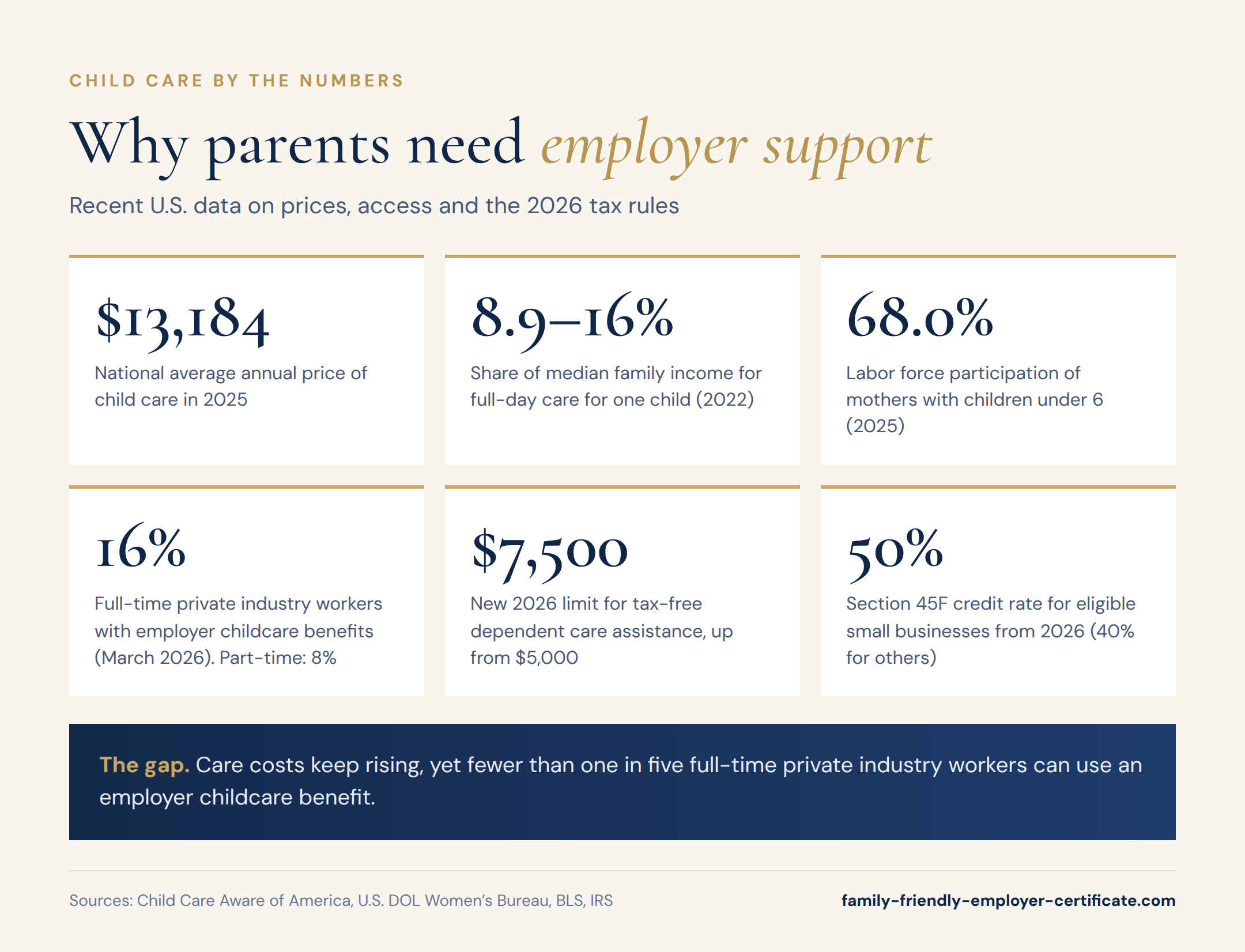
Child care in the United States is expensive and often hard to find. Child Care Aware of America puts the national average annual price of child care at $13,184 in 2025, based on its report released in May 2026. In every state with data, center care for two children cost more than median rent.
Federal data tell the same story. The U.S. Department of Labor’s National Database of Childcare Prices shows that in 2022, full-day care for one child cost between $6,552 and $15,600 a year, depending on the county, the child’s age and the type of care. That equals roughly 8.9% to 16% of median family income across the 2,512 counties in the analysis.
Those costs show up in labor supply. According to the Bureau of Labor Statistics, the labor force participation rate in 2025 was 73.9% for mothers with children under 18 and 68.0% for mothers with children under 6. For fathers, the same rates were 93.7% and 95.3%. A gap of that size is not only a family matter. It is talent that employers cannot hire or keep.
Employer help has not kept pace. In March 2026, only 16% of full-time and 8% of part-time private industry workers had access to employer-provided childcare benefits. Workers with irregular shifts, often in retail, hospitality and health care, tend to have the least support even though they face the hardest scheduling problems.
The main types of child care benefits
“Child care benefit” covers a wide range of options. Some cost little more than a policy change. Others involve contracts with providers or even a building. Most employers end up with a mix that fits their workforce, locations and budget.
Dependent care assistance programs (DCAP)
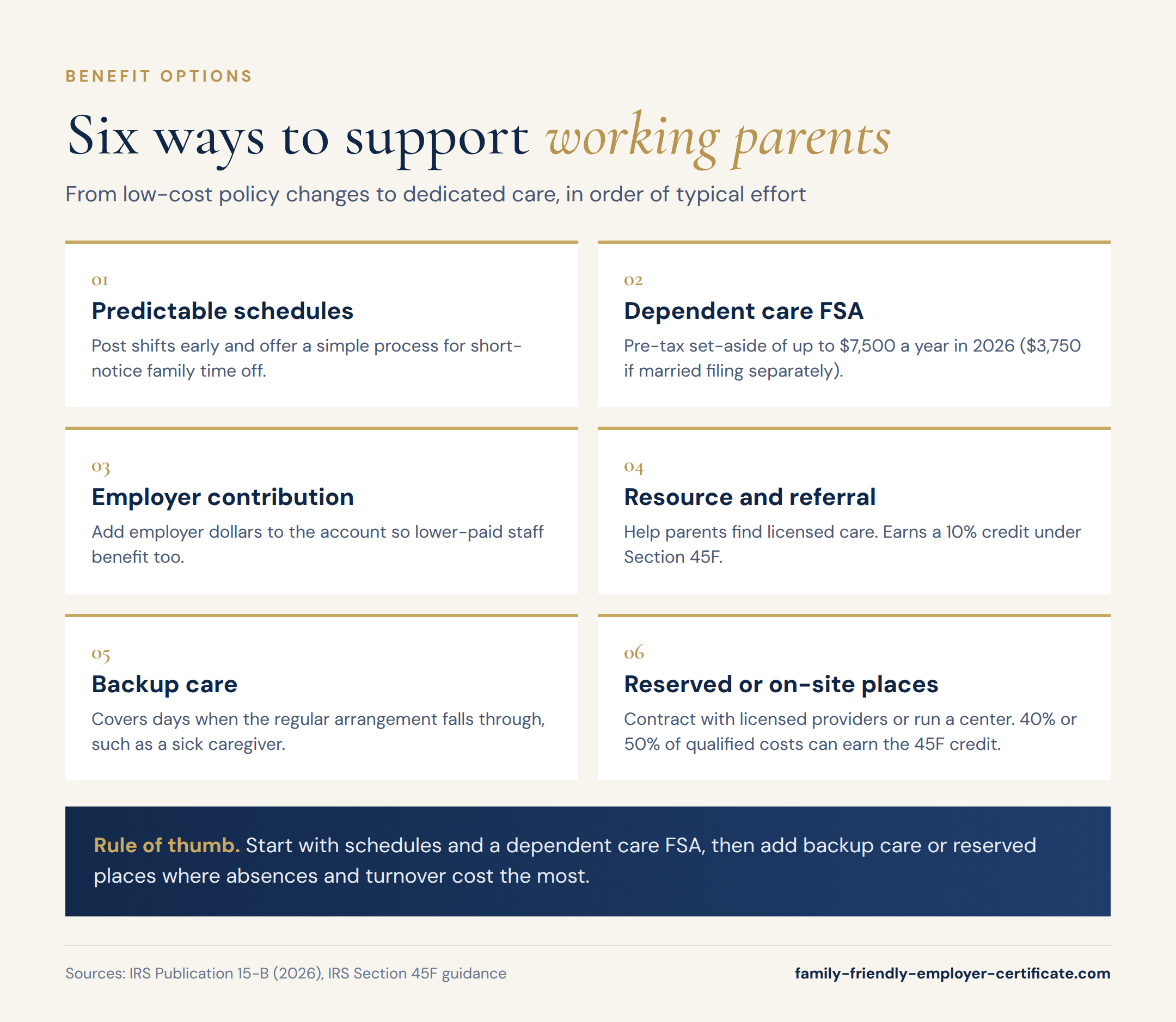
A DCAP, often called a dependent care FSA, lets employees pay for care with pre-tax dollars under Section 129 of the Internal Revenue Code. It covers care for children under 13 and for a spouse or other dependent who cannot care for themselves, as long as the care allows the employee to work. Licensed day care, preschool, before- and after-school programs and day camps usually qualify. Overnight camps do not.
Employer contributions to the DCAP
A DCAP funded only through salary reductions mostly helps employees who can afford to set money aside. Adding employer dollars, even a modest flat amount per child, makes the benefit useful for lower-paid staff as well. Employer contributions count toward the same annual limit as employee contributions.
Child care stipends and subsidies
Some employers pay a monthly amount toward care. Outside a qualified DCAP, these payments are generally taxable wages. Stipends are easy to run and flexible, but employees keep less of each dollar.
Reserved places and on-site or near-site care
Hospitals, manufacturers and other employers with fixed shifts often contract with licensed centers to reserve places, or they run their own center. Where waitlists are long, a guaranteed spot can be worth more to a parent than cash. It also makes return to work after parental leave far easier to plan.
Backup care
Backup care covers the days when the regular arrangement falls through: the nanny is sick, the center closes, or school is out for a teacher workday. It is one of the most direct ways to reduce unplanned absences, and parents tend to remember who helped them on a bad morning.
Resource and referral services
Some parents mainly need help finding care. A referral service screens local providers and open places, which can save an employee many hours of phone calls during an already stressful time.
Schedules and time policies
Not every child care benefit costs money. Shift schedules posted weeks in advance, a simple way to request short-notice family time off, and flexibility around drop-off and pick-up often matter as much as a subsidy. Our article on how family-friendly policies help you attract talent covers this side in more depth, and USIQ offers a helpful overview of the family friendly employer policies employees value most.
What changed in 2026: the tax rules employers should know
Two changes from the 2025 federal tax law known as the One Big Beautiful Bill Act make this a good year to revisit how you support working parents. The details below are general information, not tax advice, so confirm plan design and eligibility with a benefits attorney or CPA.
The DCAP limit rises to $7,500
According to IRS Publication 15-B for 2026, employees can generally exclude up to $7,500 a year of DCAP benefits from income, or $3,750 if married filing separately. The limit had been $5,000 since 1986. Using the higher limit is optional, so employers that want it need to amend the plan document and update enrollment materials and payroll settings.
Three points deserve attention:
- Nondiscrimination testing. A DCAP may not favor highly compensated employees. For 2026, that generally means 5% owners and employees who earned more than $160,000 in the prior year. Under the 55% average benefits test, the average benefit for other employees must reach at least 55% of the average for highly compensated employees. As the law firm Bradley notes, a higher limit can make this test harder to pass when mostly higher earners enroll.
- Earned income cap. The exclusion cannot exceed the earned income of the employee or the spouse, whichever is lower.
- No double benefit. Amounts excluded through a DCAP reduce the expenses an employee can use for the Child and Dependent Care Credit, as IRS Publication 503 explains. Lower-income employees may want to compare both options before enrolling.
The expanded Section 45F credit
The employer-provided child care credit is not new, but for years few businesses used it. For amounts paid or incurred after December 31, 2025, the IRS describes these terms:
- 40% of qualified child care expenditures, or 50% for an eligible small business
- plus 10% of qualified child care resource and referral expenditures
- a maximum credit of $500,000 per year, or $600,000 for eligible small businesses, with inflation adjustments after 2026
- for 2026, a corporation or partnership counts as a small business if its average annual gross receipts over the prior five years do not exceed $32 million
- payments to intermediary organizations that contract with child care facilities now qualify, and businesses may jointly own or operate a facility
- the credit is claimed on Form 8882
Qualified expenditures include acquiring, building or expanding a qualified child care facility, the costs of running one, and payments under a contract with a qualified facility to provide care for your employees. Amounts above the fair market value of the care do not count. If a facility stops operating as a qualified child care facility within the recapture period, part of the credit can be clawed back.
A simple example: a manufacturer with 70 employees pays a licensed center $40,000 a year to reserve eight infant and toddler places. If the company qualifies as an eligible small business and the contract meets the rules, the credit could reach $20,000, half of the cost. Ask your tax adviser how the credit interacts with deductions and the basis of any property.
Choosing the right mix for your company size
There is no single right package. What works depends on headcount, locations, shift patterns and the ages of employees’ children.
10 to 49 employees
Start with the basics that cost little: predictable schedules, a clear process for short-notice time off and a DCAP through your payroll or benefits provider. If the budget allows, add a small employer contribution. A referral service is an affordable next step. Our guide for small businesses that want to become more family friendly shows how small teams can compete with larger employers here.
50 to 249 employees
At this size, absences start to carry a measurable cost. Backup care, or a contract for reserved places with one or two local centers, often pays off, especially in shift-based operations. Check the 45F rules, since many companies in this range still meet the small business test.
250 employees and more
Larger employers can look at near-site centers, a partnership with other local employers (joint facilities now count for the 45F credit), or tiered subsidies that give more help to lower-paid staff.
Whatever your size, ask employees first. A short survey about children’s ages, current arrangements and the hardest moments of the week keeps you from spending money on a benefit few people need.
Does child care support pay off?
The best-known recent evidence comes from Moms First and Boston Consulting Group, which surveyed nearly 1,000 U.S. employees at five companies, including UPS, Synchrony and Etsy. Up to 86% of respondents said they were more likely to stay because of their child care benefits. The authors estimated returns of 90% to 425% for companies that invest effectively and found that retaining as few as 1% of eligible employees can cover the cost of the benefit for everyone eligible.
These are survey-based estimates from companies that chose to invest, so treat them as a direction, not a promise. Your own turnover, absence and hiring data will tell you far more about your return than any national study.
Common design mistakes to avoid
- Designing for the office only. Part-time workers have half the access of full-time workers (8% versus 16%). If a benefit does not work for evenings, weekends or rotating shifts, many parents cannot use it.
- Relying on salary reductions alone. A pure pre-tax account helps those who can spare the cash. A small employer contribution changes who benefits.
- Forgetting school-age children. Summer break, school holidays and early-release days create gaps that a day care contract does not cover. Day camps and after-school programs can be part of the answer.
- Poor communication. Many employees do not understand how a dependent care account works. Explain it with a worked example at hiring, at open enrollment and when someone announces a birth or adoption.
- Not measuring. Without usage and retention data, a benefit is hard to defend in the next budget round.
How to measure whether your support works
Track a few simple indicators: enrollment and usage by location and job group, retention of parents in the first year after parental leave, unplanned absence days, and how employees rate work-life balance and schedule flexibility. USIQ’s guide to running employee surveys that staff trust explains how to collect honest feedback and act on it.
An outside review can also help. In the Family Friendly Employer certification by USIQ, child care is part of the HR assessment area “Childcare, caregiving, and family benefits,” which carries 18 of the 100 HR assessment points across six criteria, according to the published certification criteria. Each criterion is rated for offer, access and practice, so a benefit counts fully only when employees can actually use it. A DCAP funded only by salary reductions, for example, cannot reach the top rating. The HR assessment page explains the process, and the employee survey adds the staff view, with work-life balance and working-time flexibility carrying 50 of the 100 survey points. If you are planning broader changes first, our step-by-step guide to becoming family friendly is a good starting point.
FAQ: child care benefits for employees
Are child care benefits taxable to employees?
It depends on how they are structured. In 2026, benefits paid through a qualified dependent care assistance program are generally tax-free up to $7,500 a year ($3,750 if married filing separately). Cash stipends paid outside a DCAP are generally taxable wages.
What is the dependent care FSA limit for 2026?
The limit is $7,500 per year, or $3,750 for married individuals filing separately, up from $5,000. Employer and employee contributions count toward the same limit, and employers must amend their plan to offer the higher amount.
Can a small business claim the employer child care tax credit?
Yes. From 2026, an eligible small business can claim 50% of qualified child care expenditures, up to $600,000 a year, plus 10% of resource and referral costs. For 2026, the test is average annual gross receipts of no more than $32 million over the prior five years. The credit is claimed on IRS Form 8882.
Do child care benefits have to be offered to all employees?
No federal law requires employers to offer child care benefits. If you do offer a DCAP, however, it must not favor highly compensated employees, and resource and referral services that count toward the 45F credit must not discriminate in their favor either. In practice, the fairest designs also work for part-time and shift workers.

About the author
PhDr. Oliver Scharfenberg, MBA
Oliver Scharfenberg sits on the Scientific Advisory Board of USIQ, which issues the Family Friendly Employer certificate. His doctoral thesis (2024) analyzed employer seals and included a randomized experiment with 1,093 participants on how a seal changes the way applicants react to a job ad. He previously served as a lay judge on the commercial chamber of the Regional Court of Berlin, hearing unfair competition cases, and is CEO of Syntharis Group.
Next step
Show Candidates How Work and Family Fit
The Family Friendly Employer (USIQ) certificate combines a confidential employee survey with a family-focused HR assessment against 39 published criteria. One-time packages start at $2,990.
About half of U.S. private-sector workers still lack paid family and medical leave. How to set eligibility, weeks and pay, treat every parent equally, coordinate with state programs and use the permanent 45S credit.
What makes an employer family friendly? The eight areas that count, where U.S. law sets the floor, current data on working families, and how certification checks the claim.
How small businesses can become family friendly without a big benefits budget: the rules that apply at your size, low-cost measures, federal tax credits and how certification works for teams of ten or more.