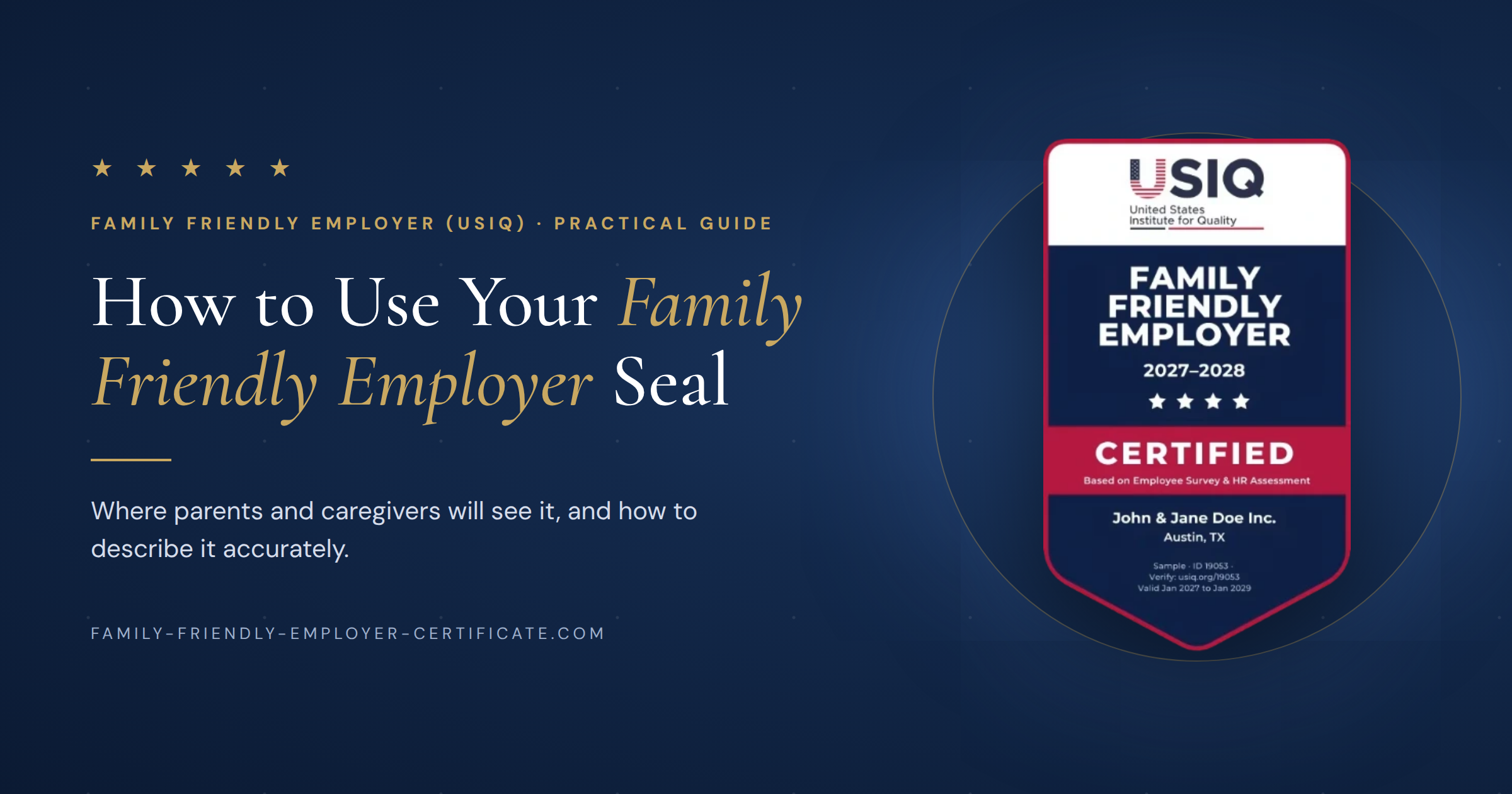
A Family Friendly Employer seal is the result of weeks of work: a survey of your whole U.S. workforce, an HR assessment with 39 criteria, documents, reviews. Once it arrives, many employers post it on LinkedIn, add it to the About page and move on. The people the seal was meant for, parents and caregivers deciding where to work next, often never see it.
This guide shows where the seal does the most good and how to talk about it so that the claim holds up. It also covers how to keep it current. We wrote it for employers who hold the Family Friendly Employer (USIQ) certificate. Most of the advice also applies to any credible employer seal.
Why visibility decides whether the seal works
Family benefits are hard to compare from the outside. A careers page does not tell a candidate whether flexible hours are real or whether fathers actually take parental leave. Nor does it show whether people who go part-time after a birth still move up. That is exactly the kind of uncertainty a seal can reduce, provided the candidate sees it at the moment of decision.
Parents pay close attention to these questions. In the UK edition of the Bright Horizons Modern Families Index 2025, 73% of working parents said they would consider an employer’s support for family life before applying for a new job or a promotion. In the United States, the Pew Research Center found that more than eight in ten working parents who are not self-employed consider paid parental, family or medical leave extremely or very helpful. Only about half have access to it.
Research on seals also suggests that visibility matters. In a randomized experiment by PhDr. Oliver Scharfenberg with 1,093 participants, the share of people who said they would likely apply rose from 37.96% to 53.94% when the same job ad carried an employer seal. The study tested a German seal, not this program, so it shows how applicants respond to seals in general. The practical lesson is simple: a seal only works if people see it. USIQ’s article Do Employer Seals Work? summarizes further research on how seals affect applicants, employees and employer image.
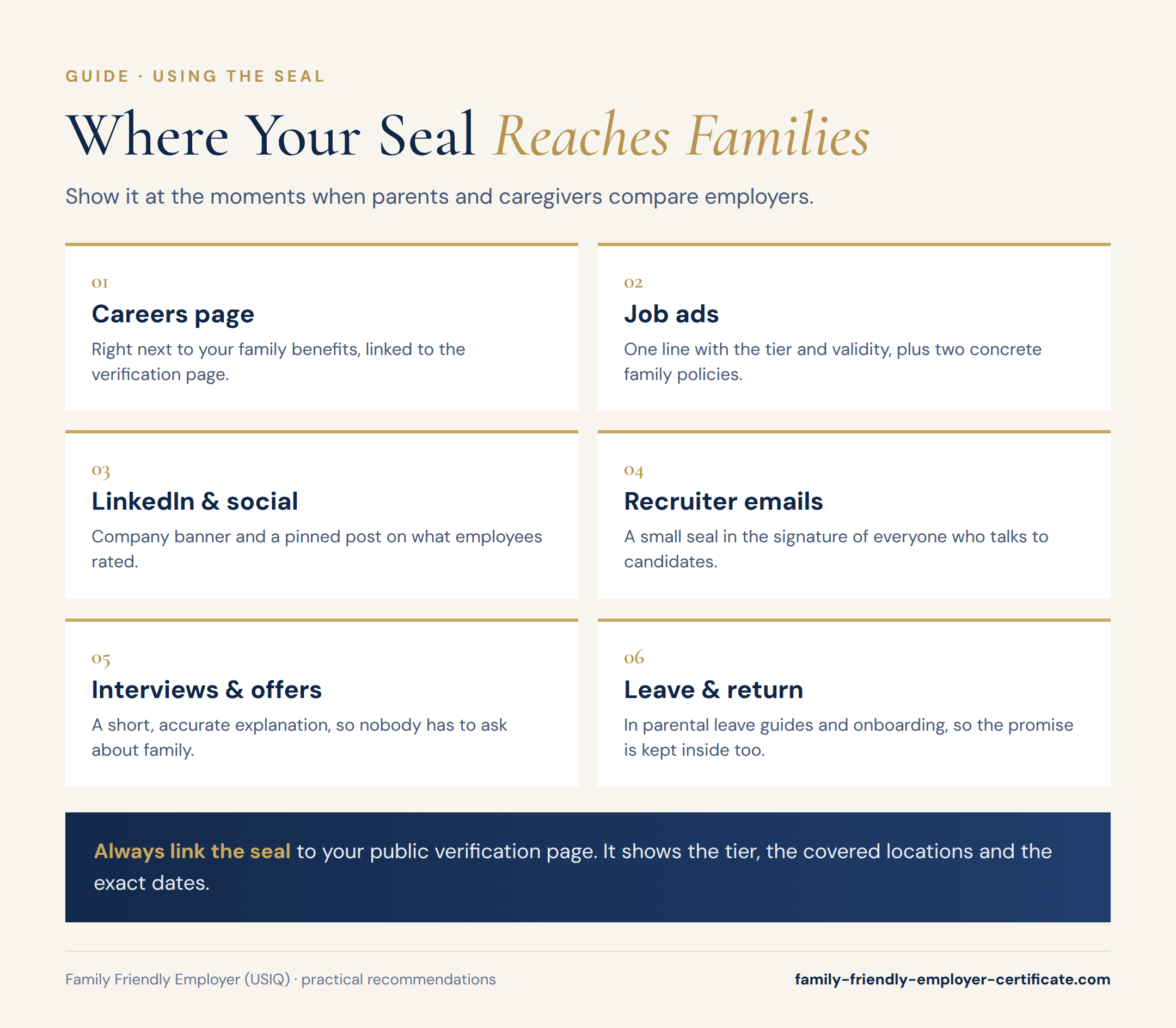
Where your seal reaches families
1. Your careers page
This is the most important place. Put the seal directly next to your family benefits, not in the footer. Add two or three plain sentences: what the assessment covered, which tier you reached and how long the certificate is valid. Then list the concrete policies that matter most to families. Examples are the weeks of paid parental leave, the rules for flexible hours and schedule notice, childcare support and what happens in a family emergency. The seal confirms the list; the list explains the seal.
2. Job ads
In a posting, text often matters more than artwork, because many job boards strip images. One line is enough, for example: “Certified Family Friendly Employer (USIQ), Gold tier, 2027–2028.” Follow it with two specific family policies that apply to this role. If the job is a shift role, say how far in advance you publish schedules. Where the platform allows links, add the verification page.
3. LinkedIn and other social channels
Use the seal in your company page banner and pin a short post that explains what the assessment measured. A post that shares one or two survey findings, for example how employees rated working-time flexibility, is more convincing than a badge alone. Employees who share the post themselves reach other parents in their own networks, which no ad can do.
4. Recruiter email signatures
A small seal in the signature of recruiters and hiring managers reaches every candidate, agency and partner they write to. Link it to the verification page as well.
5. Interviews and offer letters
Many candidates do not dare to ask about parental leave or flexibility in an interview because they fear it will count against them. The seal gives your interviewers a natural way to raise the topic themselves. Prepare them to explain it in one or two sentences: employees rated how well work and family fit together in a confidential survey, and reviewers checked HR practices against published criteria. Then point to the written policies. Interviewers should never ask candidates about their own family plans; the seal makes that unnecessary.
Mention the certification in offer letters as well, where candidates make their final comparison.
6. Parental leave guides, return-to-work materials and onboarding
The seal also works inward. Put it in your parental leave guide, your return-to-work checklist and your onboarding pack. That reminds managers what the company has committed to. It also shows new hires that the promise on the careers page applies to them. Invite them to take part in the next survey; that keeps the seal honest and makes the next certification easier.
The verification page is your strongest argument
Every Family Friendly Employer seal has a unique certificate ID and a public verification page. It shows the employer and the covered locations, the tier, the exact issue and expiration dates, the assessment period, the methodology version and the current status. Linking to it turns the seal from a picture into evidence, because candidates can check the claim in seconds.
Use the link everywhere the format allows. In print, for example on brochures or at career fairs, the seal carries a readable verification address. Nobody should rely on a seal without a working verification link or one whose dates have passed. Informed candidates know that.
Describe your Family Friendly Employer seal accurately
A seal builds trust only if the claim behind it is accurate. That also protects you. In the United States, Section 5 of the FTC Act prohibits deceptive acts and practices, and that includes how a company describes a certification in its marketing. USIQ explains on its page about FTC and EmpCo requirements which safeguards its seals use, from independent review to public verification pages.
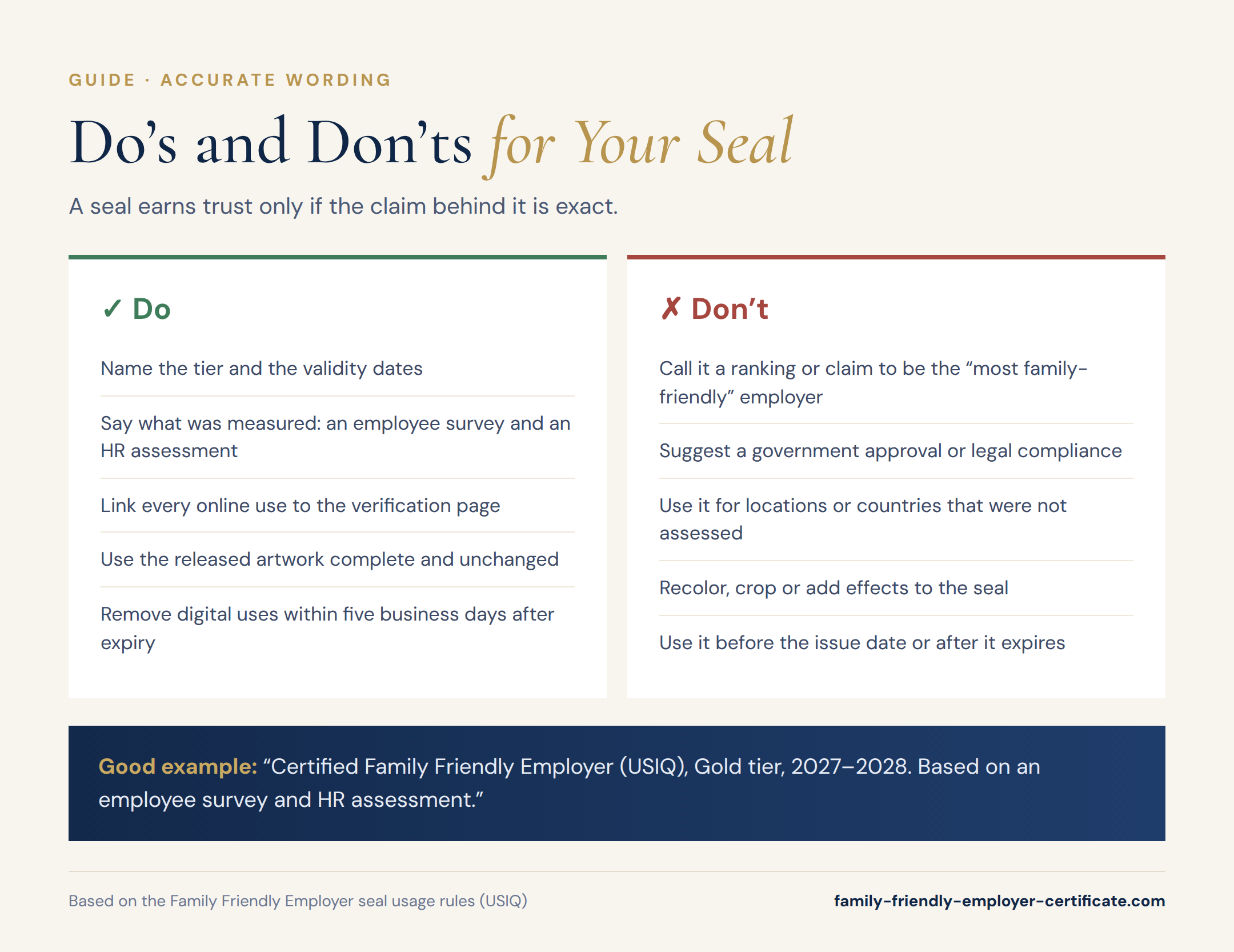
In practice, accurate wording means naming the tier and the dates, and saying what the assessment measured. It does not mean calling yourself the “most family-friendly” employer in your industry. Family Friendly Employer (USIQ) is a certification against fixed, published thresholds, not a ranking. Any number of employers can reach the same tier. A Platinum result means the company met every Platinum minimum in this assessment, nothing more and nothing less. It is also a private certification, not a government approval, and the HR assessment is not a legal compliance audit.
A few wording examples:
- Accurate seal line: “Certified Family Friendly Employer (USIQ), Silver tier, valid until March 2029. Based on an employee survey and an HR assessment.”
- Accurate context: “Our employees rated how well work and family fit together in a confidential survey. The results earned us the Family Friendly Employer seal.”
- Misleading ranking claim: “America’s most family-friendly employer.” This suggests a ranking that does not exist.
- Misleading legal claim: “Officially certified as compliant with all family leave laws.” The certificate is not a legal audit.
Follow the USIQ seal usage guidelines and use the released artwork complete and unchanged, including the tier, the dates and the line “Based on Employee Survey & HR Assessment.” Keep clear space around it and do not recolor it, crop it or add effects.
Share results, not just the badge
A seal tells candidates that an independent party checked your claims. Your survey results tell them what employees actually experience. Both together are much stronger than either alone.
You receive the aggregated survey results with your evaluation. Pick one or two findings that are relevant to families and true for the whole organization, for example how employees rated working-time flexibility or their manager’s support. Present them without exaggeration. If one area is weaker, saying so and naming what you are doing about it is more convincing to experienced candidates than a perfect picture. Employees will recognize an honest description, and they are the people candidates ask before accepting an offer.
Never publish results for groups so small that someone could identify individuals, and do not quote individual comments without permission.
Measure whether the seal makes a difference
You will not know whether the seal helps your recruiting unless you look. A few simple measures are enough:
- Ask applicants: add an optional question to your application form or first interview about what made them apply, with the seal and family policies as options.
- Compare job ads: run similar postings with and without the seal line and two concrete family policies, and compare application rates over a few weeks.
- Watch your careers page: track how often visitors open the family benefits section and click the verification link.
- Check acceptance and retention: look at offer acceptance rates and at how many employees return after parental leave and are still with you a year later.
These numbers also help when the next assessment comes up, because they show leadership what the certificate has delivered.
Use the seal only for the workforce that was assessed
A U.S. certificate covers your U.S. employees at the locations listed on the verification page. If your company also has teams elsewhere, the seal says nothing about them. The network behind the seal awards separate family-friendly employer seals for other markets: for teams in Germany and Austria, our pages on the German and Austrian programs explain the local seals and their rules.
The same applies to subsidiaries and brands. If the assessment covered only one legal entity, use the seal only for that entity.
Keep it current
The certificate is valid for 24 months from the date of issue. Put the expiration date in your calendar and plan the next assessment early, so that there is no gap. When a certificate expires, you must remove digital uses within five business days: careers page, job ad templates, email signatures and social banners. An outdated seal does more harm than no seal at all, because candidates who check it will notice.
Repeating the assessment has another benefit. The second survey shows whether the changes you made after the first one actually reached employees. If your tier improves, you have a credible story to tell; if it does not, you know where to look.
What you receive after certification
After a successful award you receive the digital seal artwork, a digital certificate and the public verification page. Depending on your package, you may also receive a company landing page, ready-made posts for Facebook, LinkedIn and Instagram, and a press release, with distribution in the Premium package. Our pricing page compares the packages, and the sample report shows what the evaluation looks like.
If you do not hold the certificate yet, our guide on how to become a Family Friendly Employer walks through the steps that lead there. Our overview of Family Friendly Employer certification in the USA explains the program for U.S. employers.
Frequently asked questions
Can we use the seal before the certificate is issued?
No. You receive the seal artwork and certificate only after a successful award. You may use them from the date of issue onward.
Can we change the colors or crop the seal to fit our design?
No. Use the artwork as released. Changing the colors, the tier or the layout makes the seal harder to recognize and can misrepresent the result.
Can we use the seal in print?
Yes, for example in brochures, at career fairs and on recruiting materials, as long as the tier and validity stay visible. The printed seal carries a readable verification address.
Can we say we are among the most family-friendly employers?
No. The certificate is not a ranking. You can say that you are a certified Family Friendly Employer, name your tier and explain what the assessment measured.
What happens if we do not renew?
The certificate expires after 24 months. You must then remove digital uses within five business days. You can apply for a new assessment at any time.

About the author
PhDr. Oliver Scharfenberg, MBA
Oliver Scharfenberg sits on the Scientific Advisory Board of USIQ, which issues the Family Friendly Employer certificate. His doctoral thesis (2024) analyzed employer seals and included a randomized experiment with 1,093 participants on how a seal changes the way applicants react to a job ad. He previously served as a lay judge on the commercial chamber of the Regional Court of Berlin, hearing unfair competition cases, and is CEO of Syntharis Group.
Next step
Show Candidates How Work and Family Fit
The Family Friendly Employer (USIQ) certificate combines a confidential employee survey with a family-focused HR assessment against 39 published criteria. One-time packages start at $2,990.
About half of U.S. private-sector workers still lack paid family and medical leave. How to set eligibility, weeks and pay, treat every parent equally, coordinate with state programs and use the permanent 45S credit.
Child care costs keep rising while few workers get any help from their employer. Here is what U.S. companies can offer, which tax rules changed in 2026, and how to measure results.
What makes an employer family friendly? The eight areas that count, where U.S. law sets the floor, current data on working families, and how certification checks the claim.