
★★★★★
Component Two · Up to 100 Points

The Family-Focused HR Assessment: 39 Criteria, Backed by Evidence

In the HR assessment, your HR team or management answers 39 family-focused criteria in eight areas online, covering the last 12 months. Each answer earns points only as far as documents and independent checks have backed it up, and every criterion is rated three ways: the offer itself, who can actually use it, and how it works in practice.

Human scoringSecond independent reviewNot a legal audit
100points8 areas · 39 criteria
A12 ptsB12 ptsC15 ptsD15 ptsE18 ptsF12 ptsG8 ptsH8 pts
39criteria
8areas
100points
12month reference period
2human reviewers

The process

Five Steps From Answers to Points

1

Digital questionnaire

An authorized representative answers all 39 criteria with Yes, No, In progress or Not applicable, plus a short explanation of who is covered, at which locations and in which work groups. Documents can be uploaded or supplied on request.

2

Public-source review

A reviewer checks careers pages, job postings, review platforms, press coverage and court or agency records, and looks for corroboration before relying on adverse information.

3

Consistency check

Approved AI tools may flag inconsistencies between materials, survey results and public information. Reviewers verify every flag; AI never scores or decides.

4

Evidence requests

USIQ may ask for proportionate evidence. You have 10 business days. Redacted extracts and aggregate records are accepted.

5

Scoring and second review

A reviewer rates offer, access and implementation for each criterion. A second reviewer independently rates the three core areas C, D and E and a random 20% of the other criteria.

Evidence levels

Points Follow the Proof

Every criterion is rated from 0 to 5, separately for the offer, for access and for implementation. The lowest of the three ratings counts. “Corroborated” means supported by documents in this assessment, not a legal audit or a guarantee.

0Absent

Reliable evidence shows the practice does not exist.

1Unsubstantiated

A plan or claim without enough documentation, or requested evidence was not provided.

2Partial

Important requirements are incomplete, access is restricted, or the practice only partly works.

3Established

The current arrangement meets the main requirements; corroboration is limited.

4Substantially corroborated

Well evidenced across the relevant work groups, with minor gaps.

5Fully corroborated

All requirements are documented and corroborated within scope, with no material gaps.

Scoring

How the 100 Points Are Split

Criteria carry equal weight within an area, and each one counts at the lowest of its three ratings. The area score is the average level divided by 5, multiplied by the area’s points.

ExampleArea C

Flexible work and working time, 15 points, 6 criteria

Average level4.0

Mean of the six criterion levels

Normalize4 ÷ 5 = 0.8

Share of the maximum level

Area points0.8 × 15 = 12

All eight areas add up to 0–100

AFamily-conscious work organization and scheduling12 pts
BLeadership commitment and family-aware management12 pts
CFlexible work and working-time models15 pts
DPregnancy, parental leave and return to work15 pts
EChildcare, caregiving and family benefits18 pts
FFairness and nondiscrimination for parents and caregivers12 pts
GFamily-friendly employer branding and candidate experience8 pts
HLife events, family emergencies and transitions8 pts

Rules that matter

What Counts, and What Doesn't

Benefits beyond the law

Only what goes beyond federal, state and local requirements earns benefit credit (criteria D1, D3, E1–E6, H1 and H3). Full credit needs access for at least 80% of the covered workforce; below that, a criterion is capped at level 2.

Missing evidence

If requested evidence is not supplied or adequately replaced, that criterion is limited to level 1.

“Not applicable” needs a reason

It requires a documented objective reason and USIQ approval. Lacking a practice is not a reason, and at least half of the criteria in every area must remain applicable.

No legal verdict

The HR assessment is not a legal-compliance audit. Submit redacted policies and aggregate records, never personnel files, medical certifications or details about an individual employee’s family.

The questionnaire

All 39 Criteria, Area by Area

Summarized from Part 3 of theFamily Friendly Employer Certification Criteria, version 2026-1.3, where you will find the full wording. The evidence examples are illustrative; equivalent, relevant material is accepted.

Area AFamily-Conscious Work Organization and Scheduling

12points · 5 criteria
No.CriterionEvidence for level 4–5
A1Work schedules and shift plans are published at least 14 calendar days in advance, and short-notice changes are tracked.Scheduling rules, notice and change statistics, change logs
A2Meetings, mandatory training and company events take place within agreed working hours, with alternatives for night, weekend, part-time and on-site groups.Meeting rules, event calendar, records of alternatives
A3Cover is planned for parental and family leave and for short-notice care absences, so colleagues are not routinely overloaded.Cover and backfill rules, aggregate overtime records
A4Goals, workload and targets are adjusted for reduced hours, phased returns and periods of leave.Goal-setting guideline, redacted examples
A5Employees can take short-notice time off for urgent family matters through a simple process that works on every shift.Emergency-time policy, request statistics

Area BLeadership Commitment and Family-Aware Management

12points · 5 criteria
No.CriterionEvidence for level 4–5
B1Senior management has committed to family-friendliness in writing, with objectives and a named owner, and reviews the commitment every year.Signed policy statement, review minutes
B2Managers are trained in family-supportive leadership; new managers complete the training within six months.Curriculum, completion rates, learning checks
B3A designated person advises employees confidentially on family benefits, leave and return to work.Role description, number of consultations
B4Employees are involved in identifying family-related needs, and the resulting actions are documented.Survey or workshop format, results, action log
B5Family policies are written down, easy to find and communicated to every relevant work group.Benefits guide, communication records

Area CFlexible Work and Working-Time Models · core area

15points · 6 criteria
No.CriterionEvidence for level 4–5
C1Employees have a say over when they work wherever their tasks allow.Options by work group, eligibility, known barriers
C2Remote or hybrid work is possible under clear rules where the job allows, with the equipment needed.Eligibility rules, alternatives for on-site roles
C3Part-time work is possible at every level, including management, with pay and benefits in proportion.Part-time policy, aggregate part-time shares
C4Further models such as job sharing, compressed weeks, annualized hours and shift swaps are offered where feasible.Swap rules, access overview, aggregate requests
C5Requests to change working time get a written answer within 30 calendar days.Request policy, status counts, response times
C6After a temporary family-related reduction, employees can return to their previous hours.Return terms, implementation or readiness evidence

Area DPregnancy, Parental Leave and Return to Work · core area

15points · 6 criteria
Benefit credit applies to D1 and D3 only. Benefits the law already requires do not count, only what the employer adds on top.
No.CriterionEvidence for level 4–5
D1Every new parent receives employer-paid parental leave. Full credit starts at six weeks at two-thirds or more of base pay, on top of any state benefit.Leave policy, state baseline, utilization
D2Pregnant and postpartum employees and applicants get reasonable accommodations through a prompt interactive process.Accommodation procedure, response times
D3Lactation support goes beyond the federal minimum: a private, lockable space, paid break time and ongoing support.Room description, lactation policy
D4A structured planning conversation takes place before leave, with optional keep-in-touch arrangements during leave.Planning checklist, keep-in-touch guideline
D5Returning parents get re-onboarding and a phased or reduced-hour return; return and retention rates are monitored.Return policy, aggregate return rates
D6Leave and pregnancy never lower performance ratings, cost anyone variable pay for time worked, or exclude anyone from reviews and promotion.Performance and pay-review guidelines

Area EChildcare, Caregiving and Family Benefits · core area

18points · 6 criteria
Only provision beyond federal, state and local requirements earns benefit credit. Full credit requires access for at least 80% of the covered workforce. The employer-provided child care credit under IRC §45F is not assessed.
No.CriterionEvidence for level 4–5
E1Childcare support: on-site or near-site care, reserved places, subsidies or backup care.Provider contract or subsidy policy, utilization
E2A dependent care assistance program (IRC Section 129) with an employer contribution.Plan summary, eligibility
E3Health coverage extends to spouses or domestic partners and dependents, with the employer paying at least 50% of the premium.Contribution rates by coverage tier
E4Support for employees who care for an elderly or adult family member.Vendor contract, service description
E5Family-building support, available regardless of sexual orientation, gender or marital status.Policy, eligibility, plan documents
E6Paid time to care for family members beyond what the law requires.PTO and sick-leave policy, comparison with legal baseline

Area FFairness and Nondiscrimination for Parents and Caregivers

12points · 5 criteria
No.CriterionEvidence for level 4–5
F1A written policy prohibits discrimination, harassment and retaliation related to pregnancy, parental status, caregiving and the use of family leave or flexible work, with a reporting channel.Policy, training records, reporting channel
F2Family status or family plans play no role in hiring, promotion and assignments.Interview guidelines, interviewer training
F3Part-time, remote, flexible and returning employees have fair access to evaluation, development and promotion.Aggregate opportunity and selection analysis, corrective actions
F4Family-related information, such as pregnancy, leave reasons or accommodations, is kept confidential, shared on a need-to-know basis and stored separately where the law requires.Privacy notice, access controls, retention schedule
F5Pay equity is reviewed at least every 24 months, including the effect of leave, part-time periods and caregiving breaks, and the findings are acted on.Nonprivileged description of the review and corrective action; no privileged analyses or individual salaries

Area GFamily-Friendly Employer Branding and Candidate Experience

8points · 3 criteria
No.CriterionEvidence for level 4–5
G1Family offerings are described accurately on the careers site and in job postings, without overstating who can use them or what they are worth.Careers site, sample postings, comparison with policy documents
G2Hiring works around caregiving, for example with flexible or video interviews or childcare reimbursement for on-site interviews, and postings say whether part-time, flexible or remote work is possible.Process description, sample postings, candidate feedback
G3Candidates returning from a caregiving break are actively considered, employment gaps are not held against them, and former employees have a defined rehire or returnship route.Returnship or re-entry program, hiring guidelines

Area HLife Events, Family Emergencies and Transitions

8points · 3 criteria
Benefit credit applies to H1 and H3.
No.CriterionEvidence for level 4–5
H1Paid bereavement leave goes beyond legal minimums for an inclusively defined circle of close family, including after pregnancy loss, a failed adoption or unsuccessful fertility treatment.Bereavement policy, family definition, legal baseline
H2Employees can get confidential counseling and practical support for family matters, for example through an EAP covering parenting, elder care and serious illness or disability in the family.EAP contract and scope, aggregate utilization
H3Extended family-related career breaks or leave beyond legal requirements, with a guaranteed return to the same or a comparable role, options to keep benefits and flexible transitions for long-term caregivers.Policy, redacted examples

Employer declaration

Signed Before Anything Is Scored

An authorized officer confirms the submission. The declaration is required but not scored, and a materially false declaration can lead to refusal or revocation.

After reasonable inquiry, an authorized officer confirms that the answers and evidence are accurate and complete in all material respects, that known material departures from workplace law and relevant enforcement matters from the past 24 months have been disclosed, that benefits described as available really are available on the stated terms, and that no favorable survey response was required or induced.

Summarized from the Family Friendly Employer Certification Criteria 2026, Part 3.
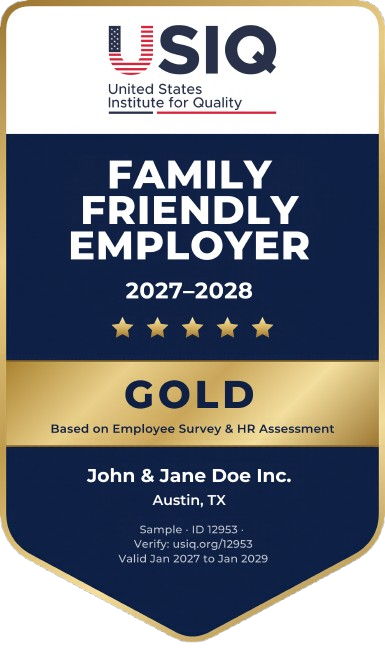
Family Friendly Employer (USIQ) Gold seal (sample)

What you receive

Every Area,With Its Score

Your evaluation comes as an Excel file covering the survey and the HR assessment, so you can see where points were gained and where documentation was missing.